
What Is Online Arbitrage? How It Works on Amazon in 2026
 Max VershininFounder of Arbitrage Hero
online arbitragewhat is online arbitrageamazon fbagetting started
Ask AI to summarize this article:





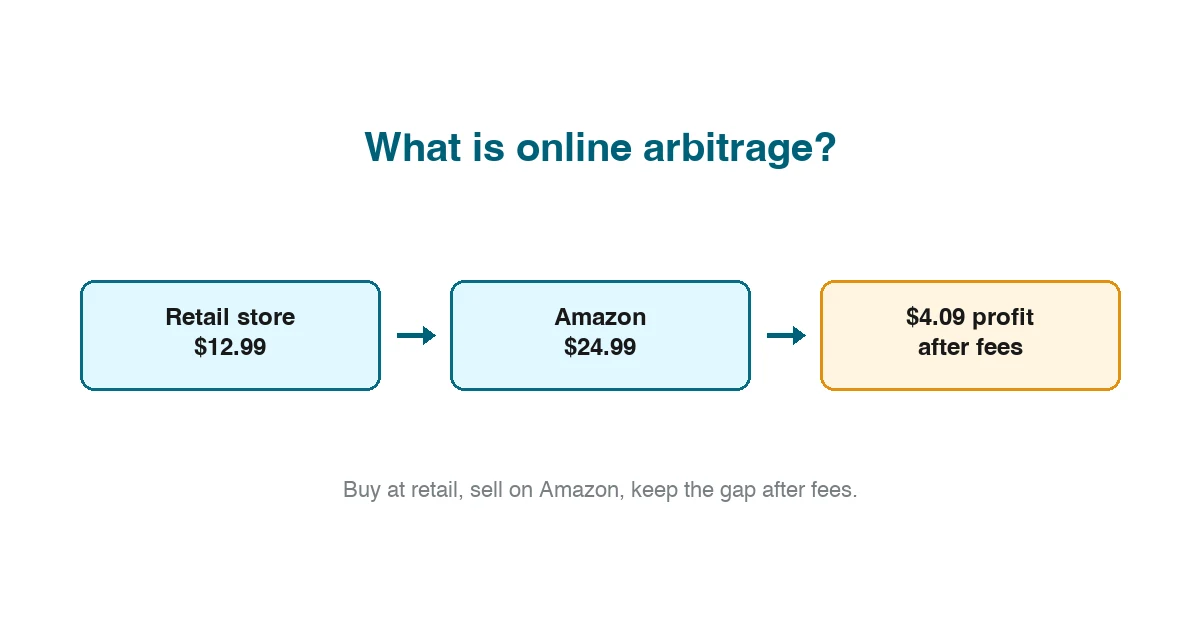
Short answer: online arbitrage is buying products from ordinary retail websites at a price low enough to resell them on Amazon at a profit after Amazon's fees. The product is genuine, bought at retail like any other purchase; the margin comes from the gap between what a store charges and what the same item sells for on Amazon.
That one sentence hides three real jobs: finding the price gaps, checking that a gap survives Amazon's fees, and doing both fast enough that the gap still exists when your stock arrives. This article walks through how the model works, what a real unit of it looks like in numbers, whether it is legal, what it costs to start, and where it goes wrong.
How does online arbitrage work?
The cycle is the same whether you do one flip a month or run it as a business:
- Find a price gap. A product sells on a retail site for less than its Amazon price. Gaps appear constantly: clearance events, coupon stacking, regional pricing, or a retailer simply not watching Amazon.
- Check the real margin. The sticker gap is not the profit. Amazon takes a referral fee on every sale and a fulfilment fee on every FBA unit, and the product has to be one you are allowed to sell. The maths on this step is what separates a deal from a donation.
- Buy at retail. You order from the store's website like any customer, often with cashback or discounted gift cards stacked on top.
- Send stock to Amazon. Under FBA, Amazon stores the units, ships orders, and handles returns and customer service.
- Price, sell, repeat. The listing already exists with its reviews and its sales history; you join it as another seller. What you reinvest, you can flip again.
Nothing in that loop needs a brand relationship, a wholesale account or a private label launch. That is why online arbitrage is the usual first model for new Amazon sellers, and why the barrier to entry is capital and attention rather than contacts.
What does one unit look like in numbers?
Here is the arithmetic on a single, ordinary flip. The figures are an example, not a live offer:
| Line | Amount |
|---|---|
| Buy price at the retail store | $12.99 |
| Sale price on Amazon | $24.99 |
| Referral fee (15% category rate) | −$3.75 |
| FBA fulfilment fee (small standard unit, in this example) | −$4.16 |
| Profit per unit | $4.09 |
| ROI on the cash spent | 31% |
Two things to notice. First, roughly a third of the sale price went to Amazon before any profit appeared - which is why step two of the cycle is not optional. The full fee picture, including the four conditional fees most summaries skip, is in our breakdown of Amazon's 2026 FBA fees. Second, the ROI is on the $12.99 you spent, not on the sale price: online arbitrage returns are usually quoted this way because the cash you put in is the thing you are trying to grow. You can run this arithmetic on any product with our free FBA profit calculator - no signup, US and UK marketplaces.
Is online arbitrage legal?
Yes. In the United States, reselling a genuine product you lawfully bought is protected by the first-sale doctrine, codified in 17 U.S.C. §109: once a genuine item has been sold once, the rights holder does not control its resale. You do not need a brand's permission to resell its product, any more than a used bookshop needs a publisher's permission.
Legal is not the same as friction-free, and the distinction matters. Amazon is a private marketplace with its own policies: some brands and categories are gated and need approval before you can list, and a brand can file an intellectual-property complaint that you then have to answer with receipts. These are marketplace-policy problems, not legality problems - but they are real, and keeping retail receipts for everything you sell is the standing defence.
What is the difference between online and retail arbitrage?
The sourcing location. Retail arbitrage means physically walking store aisles and scanning clearance shelves with your phone; online arbitrage does the same hunt on the stores' websites from a desk. The three sourcing models, wholesale included, get a full comparison of their own. Online scales better - you can check thousands of products across hundreds of stores in the time a store visit takes - while retail sometimes finds local clearance prices that never appear online. Many sellers run both, and the Amazon side of the process is identical from the moment the stock is bought.
How much money do you need to start?
Less than almost any other Amazon model, because you can buy single units. A private label launch needs a manufacturing run; wholesale needs minimum order quantities; online arbitrage lets you test a product with one $13 purchase. A few hundred dollars is enough to learn the cycle with real stakes, and the same cash recycles: buy, sell, reinvest.
The honest caveat is that small capital means small absolute profits while you learn - the point of starting small is cheap lessons, not fast income. There are also standing costs to budget around the stock itself: an Amazon Professional account, prep supplies, and inbound shipping to Amazon's warehouses.
What are the risks?
Four account for most of the money lost in this model:
- Price drops. The gap you bought into can close before your stock sells - other sellers find the same deal, or Amazon itself drops the price. Checking a product's price history before buying, not just its price today, is the standard defence.
- Gating and IP complaints. The product arrives at the warehouse and you discover you cannot list it, or a brand challenges the listing. Checking eligibility before buying, and keeping receipts after, covers most of this.
- Slow-moving stock. A profitable price on a product nobody buys is not profitable - it is storage fees. Sales rank history tells you whether the demand is real before you commit.
- Miscalculated fees. A margin that ignores the fulfilment fee, or the fact that apparel returns cost money, evaporates on contact with the settlement report. Calculate with all fees in, every time.
Do you need software for online arbitrage?
Not to start. Your first flips can be found by hand: browse a clearance section, check each interesting product against Amazon, run the numbers through a free calculator. Doing it manually first is genuinely useful - you learn what a good deal feels like before you automate the search for one.
The hand method stops scaling quickly, though. Checking one product takes minutes; a clearance section holds thousands; the gaps are shared with every other seller looking at the same page. Sourcing software exists to do the checking at scale - Arbitrage Hero scans hundreds of US and UK retail stores against Amazon and returns the products worth a look with profit, fees and ROI already calculated. What that category of tool does and how the options compare is a separate guide; the short version is that software changes how many gaps you can check, not whether the model works.
Where to go from here
If the model makes sense to you, the next questions are practical ones: which stores and categories to hunt in, how to read a price history chart, and what to buy first. Our step-by-step starting guide covers the sequence, and if you are reading this in the second half of the year, the Q4 sourcing guide explains why the last quarter is when this model works hardest.