
Amazon FBA Fees in 2026: The Seven Fees and When Each One Applies
 Max VershininFounder of Arbitrage Hero
fba feesamazon feesreferral feestorage feesonline arbitrage
Ask AI to summarize this article:





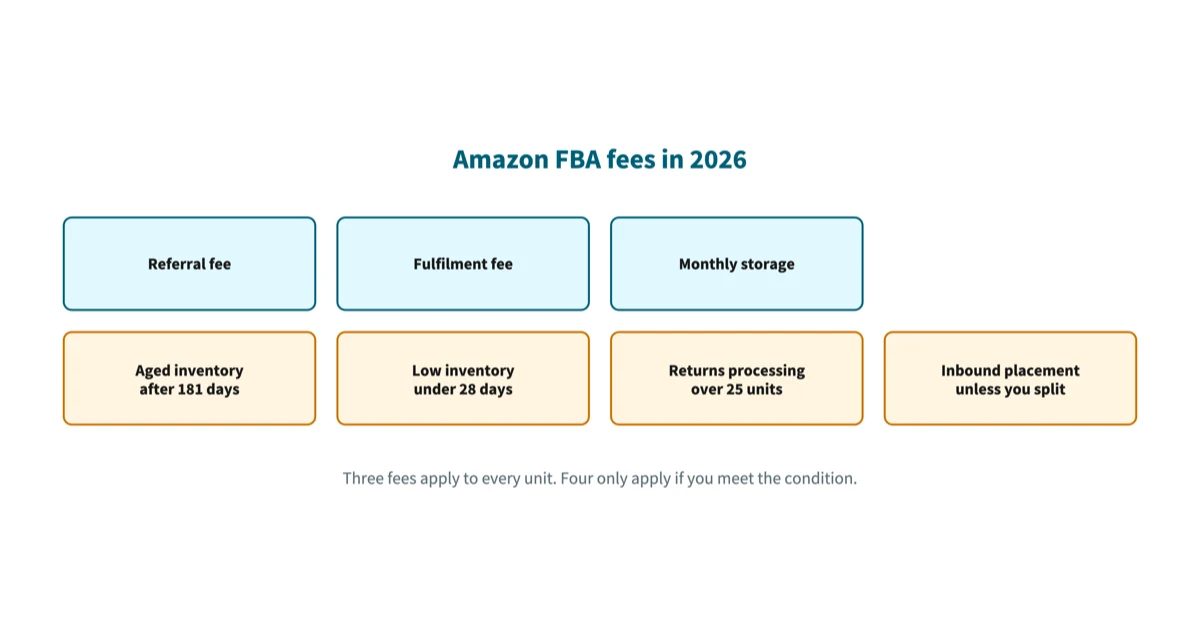
Short answer: selling and holding one unit through FBA can trigger seven separate fees. Two of them are unavoidable: the referral fee and the fulfilment fee, charged on every unit that sells. Monthly storage is charged on every unit you hold, for as long as you hold it. The remaining four apply only when a stated condition is met. Two of those conditions are sales-volume thresholds you can check against your own numbers. One is a choice you make when you send the shipment. The last is the age of the stock. Every rate below is quoted from Amazon's own fee pages, read on 4 August 2026.
Many fee summaries list all seven as though all seven were certain. Amazon's documentation does not say that. The eligibility rules sit on the same pages as the rate cards, and they are the part the summaries leave out. This article reads those pages and separates the fees that arrive on their own from the fees you have to meet a condition to be charged.
One note on scope. The seven below are the fees a sale or held stock can trigger by itself. Amazon charges for other FBA services on request, and those are outside this list. They include removal, disposal and liquidation orders, which you pay when you want stock back or destroyed. They also include the FBA Prep Service, the FBA Label Service, the manual processing fee, and the inbound defect fee for shipments that arrive late or in the wrong place.
Amazon states each of the seven fees on its own page
Before any of the seven there is the selling plan itself. A Professional account is $39.99 a month, and an Individual account is $0.99 per item sold. That is a cost of selling on Amazon at all, not an FBA fee, and it is the one figure in this article that does not depend on the product.
| Fee | What triggers it | Amazon's page |
|---|---|---|
| Referral fee | Every sale, FBA or not. A share of the total sale price, 5% to 45% by category, with a minimum of $0.30 in most categories | Standard selling fees |
| FBA fulfilment fee | Every unit Amazon picks, packs and ships. Set by size tier, shipping weight and now also by price band | 2026 US FBA fulfillment fee changes |
| Monthly inventory storage | The space your stock occupies, charged every month per cubic foot | Monthly inventory storage fees |
| Aged inventory surcharge | Stock still in the warehouse 181 days after it arrived | Aged inventory surcharge |
| Low-inventory-level fee | Stock too thin against your own demand: under 28 days of supply | Low-inventory-level fee |
| Inbound placement service fee | Sending a shipment to fewer fulfilment centres than Amazon asked for | FBA inbound placement service fee |
| Returns processing fee | A return rate above that product's threshold. In apparel and shoes, every returned unit | 2026 returns processing fee changes |
Three of the seven have a threshold you may never reach
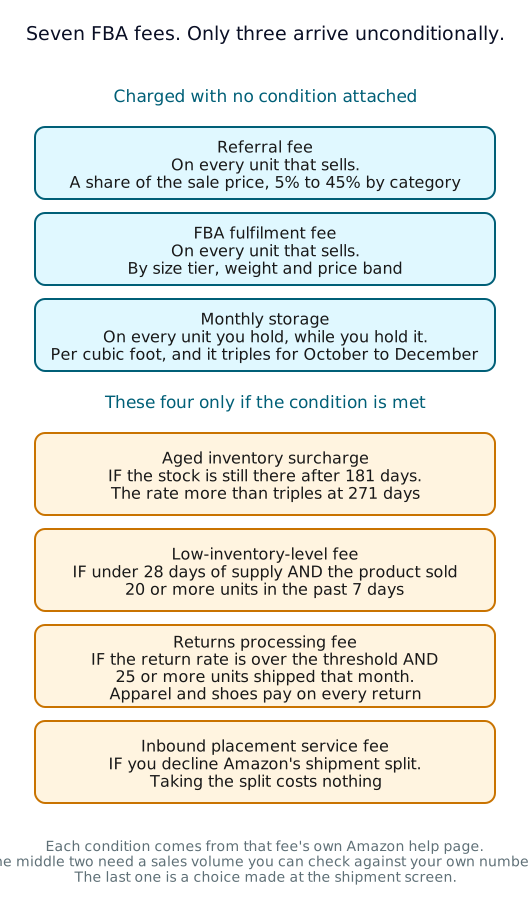
Three fees carry a volume threshold or an opt-out, and Amazon states each one in plain words on that fee's own page. These are worth checking against your own sales before you budget for them, because below the threshold the fee is not reduced, it is not charged at all.
| Fee | What Amazon's page says | What that means for a small seller |
|---|---|---|
| Low-inventory-level fee | The fee does not apply to "Products that have sold less than 20 units in the past 7 days" | A product that has sold under 20 units in the past 7 days is not charged at all, however thin the stock is |
| Returns processing fee | "Your product is exempt from this fee if it shipped fewer than 25 units in a month" | A product that never ships 25 units in a month cannot reach the threshold. Apparel and shoes are the exception and pay on every return |
| Inbound placement service fee | Amazon-optimized shipment splits carry "No fee" | This fee is optional. Splitting the shipment the way Amazon asks costs nothing |
The low-inventory-level fee has two further exemptions worth knowing, both on the same page: new Professional sellers do not pay it for the first 365 days after their first inventory arrives, and a product new to FBA is exempt for its first 180 days. Grocery products became exempt on 15 January 2026.
Both volume thresholds are low enough that they are worth measuring rather than assuming. Two numbers answer it: units sold in the past 7 days, and units shipped in the calendar month. If a product sits under 20 and under 25, two of the seven fees cannot reach it at all.
That leaves the fourth conditional fee, the aged inventory surcharge. It has no volume threshold under it at all: its condition is the age of the stock. Amazon does exclude certain items from its earlier age bands, so check the rate card for your own category. It is covered in the next section but one.
What a typical arbitrage unit costs in 2026
Take a large standard-size product weighing just under a pound, sold at $25. Two fees apply on the day it sells. The referral fee at the common 15% rate is $3.75. The fulfilment fee for that size and weight in the $10 to $50 price band is $4.60 between 15 January and 14 October 2026. Amazon takes $8.35, leaving $16.65 before your buy price, your prep and your inbound shipping.
Storage is charged separately and per month. The base rate for standard-size, non-dangerous goods is $0.78 per cubic foot from January to September. A unit that occupies a tenth of a cubic foot, roughly a 9 by 6 by 3 inch box, therefore costs about 8 cents a month to keep. From October to December the same rate is $2.40 per cubic foot, so the same unit costs about 24 cents a month.
Fulfilment fees rise for the holiday period too. A small standard-size unit of 2 oz or less in the $10 to $50 band is $3.32 in the non-peak window and $3.51 from 15 October 2026 to 14 January 2027. The gap is small per unit and it lands on exactly the stock you shipped in for Q4. Our FBA profit calculator applies the referral and fulfilment fees to a real buy price, which is the pair that decides whether a deal is worth taking at all.
The aged inventory surcharge rises sharply after 270 days
Monthly storage is predictable. The aged inventory surcharge is not, because the rate does not climb evenly. It starts at 181 days and steps up on the schedule below, which is Amazon's full 2026 rate card for standard products.
| Days in the warehouse | Surcharge from 16 January 2026 |
|---|---|
| 181 to 210 | $0.50 per cubic foot |
| 211 to 240 | $1.00 per cubic foot |
| 241 to 270 | $1.50 per cubic foot |
| 271 to 300 | $5.45 per cubic foot |
| 301 to 330 | $5.70 per cubic foot |
| 331 to 365 | $5.90 per cubic foot |
| 366 to 455 | $6.90 per cubic foot, or $0.30 per unit, whichever is greater |
| 456 or more | $7.90 per cubic foot, or $0.35 per unit, whichever is greater |
Read the fourth row again. Between 270 and 271 days the surcharge goes from $1.50 to $5.45 per cubic foot, more than three times, in one step. The first three bands are small next to the fourth, but they are charged on top of monthly storage, so they belong in the margin rather than out of mind. Amazon notes that those first three bands exclude certain items, so check the page for your own category.
Nine months is therefore the date to plan around, not the 181-day start. A product that has not sold by 240 days needs a decision, because the step lands 30 days later.
What changed on 15 January 2026
Amazon's 2026 US Referral and FBA fee changes summary states the headline itself: "In 2026, FBA fees will increase by an average of $0.08 per unit sold, or less than 0.5% of an average item's selling price." The same page promises "no new FBA fee types in 2026" and says sellers get "at least 90 days before any fee increases take effect". An average is an average, though, and the spread underneath it is wide. Every figure in the table below comes from that page.
| Standard-size fulfilment fee change | Average per unit |
|---|---|
| Small, priced below $10 | up $0.12 |
| Small, priced $10 to $50 | up $0.25 |
| Small, priced above $50 | up $0.51 |
| Large, priced $10 to $50 | up $0.05 |
| Large, priced above $50 | up $0.31 |
The pattern is that higher-priced items absorbed most of the increase, and that cheap products were protected. Products priced below $10 now receive a fee discount of $0.86 per unit on average, up from $0.77. Two other changes matter to anyone holding stock. The minimum aged inventory fee for items 12 to 15 months old rose $0.15, to $0.30 per unit per month. And a new tier was added for items over 15 months, at $0.35 per unit or $7.90 per cubic foot, whichever is greater.
Where Amazon's own documentation makes this harder than it needs to be
Three things stood out while reading these pages, and all three are checkable by opening the same links.
- The public pages name the fees and publish almost none of the rates. Amazon's FBA page lists fulfilment, storage, aged inventory, returns processing, removal and inbound placement, then says "Costs for FBA depend on the products you sell and the exact services you use." The pricing page does publish the selling plan cost and the referral percentages. It publishes no FBA rate at all. That split runs through this article: the selling plan cost and the referral rates come from Amazon's public pricing page, and every FBA figure comes from a Seller Central help page.
- The page titled "2026 US Referral and FBA fee changes summary" contains no referral fee change. Its sections cover FBA fees, Coupons fees, and the AWD, Multi-Channel Fulfillment and Buy with Prime fees. There is no referral section at all. A seller reading the title to find out what happened to referral fees has to infer the answer from an absence, which is a poor way to publish good news.
- One sale's fees are spread across seven pages. Each fee has its own page, its own size tiers and its own effective dates, and several carry both the old and the new rate card on the same screen. Pricing one unit properly means opening at least three of them and reading which date range you are in.
What to do with this
- Price every deal on the referral fee and the fulfilment fee alone. Those two apply to every unit and together they are most of what Amazon takes. If a deal does not work on those, the other five will not save it.
- Accept Amazon's optimized shipment splits unless you have a specific reason not to. It is the only fee on this list with a published $0 option, and declining it costs between $0.14 and $1.90 per unit for standard-size stock.
- Know what 1 October costs you. Storage triples and fulfilment fees rise for the peak window. That is a reason to send stock that will genuinely sell in Q4 and to think twice about the rest, but it is only one side of the sum: holding stock back also means the Q4 sales it would have made. Weigh the extra fees against the margin you expect, not against zero.
- Put a reminder at 240 days for anything still in the warehouse. The aged surcharge more than triples at 271 days, so the decision to remove or discount has to be made before that step, not after it.
- If you sell apparel or shoes, model returns from the first deal. Those two categories pay a returns processing fee on every returned unit, with no rate threshold and no 25-unit floor.
- Read the fee announcement in the autumn, not in January. Amazon gives at least 90 days of notice for changes that take effect on 15 January, so the announcement lands around October. January is when the new rates start charging, which is too late to plan around them. Check again just before 15 January to confirm what shipped.
Frequently asked questions
How much does Amazon FBA cost per sale?
For a $25 large standard-size product weighing just under a pound, Amazon takes $8.35 on the sale in 2026: a $3.75 referral fee at the common 15% rate, plus a $4.60 fulfilment fee. Storage is charged on top, monthly, at $0.78 per cubic foot from January to September. Referral rates run from 5% to 45% depending on category, so the total varies more by what you sell than by what it weighs.
Does the low-inventory-level fee apply to online arbitrage sellers?
Only above a sales threshold you can check yourself. Amazon's own page exempts "Products that have sold less than 20 units in the past 7 days", so an SKU under that rate is not charged at all. The fee also needs both the 90-day and the 30-day days-of-supply figures to sit below 28 days before it applies. New Professional sellers are exempt for 365 days, and a product new to FBA for its first 180 days.
How do you avoid the FBA inbound placement service fee?
Send the shipment the way Amazon asks. The fee exists to price the convenience of sending everything to one location, and Amazon states that its optimized shipment splits carry "No fee". Choosing minimal splits instead costs $0.14 to $1.90 per unit for standard-size products, depending on weight. The trade is your own time and inbound shipping across more destinations against a per-unit charge.
When does Amazon start charging the aged inventory surcharge?
At 181 days in the fulfilment centre, starting at $0.50 per cubic foot per month. The rate steps up roughly every 30 days after that. The step that matters is at 271 days, where it jumps from $1.50 to $5.45 per cubic foot. Items over 456 days pay $7.90 per cubic foot or $0.35 per unit, whichever is greater.
Did Amazon raise referral fees in 2026?
Amazon's 2026 changes summary announces none. The page is titled "2026 US Referral and FBA fee changes summary" but lists no referral fee change anywhere in its body, so the referral rates to use are the ones on Amazon's public pricing page: 5% to 45% by category, with a $0.30 minimum in most. The increases that page does announce are on the FBA side, averaging $0.08 per unit sold, plus separate changes to Coupons, AWD, Multi-Channel Fulfillment and Buy with Prime fees.
Keep reading
- The FBA profit calculator puts the referral and fulfilment fees against a real buy price, and gives you the breakeven sale price.
- Amazon FBA Q4 2026 deadlines has the inbound dates that decide whether your stock is live for the peak fees you are paying.
- How accurate Amazon sales estimates are matters here, because how fast a product sells is what decides whether you ever meet the storage and aged inventory fees.
- Choosing replenishable products is the other side of the low-inventory-level fee: steady sellers are the ones where days of supply becomes worth managing.
- Is online arbitrage still worth it works through the margins these fees leave behind.