
Online Arbitrage vs Retail Arbitrage vs Wholesale: Which Amazon Model Fits You
 Max VershininFounder of Arbitrage Hero
online arbitrageretail arbitragewholesaleamazon business models
Ask AI to summarize this article:





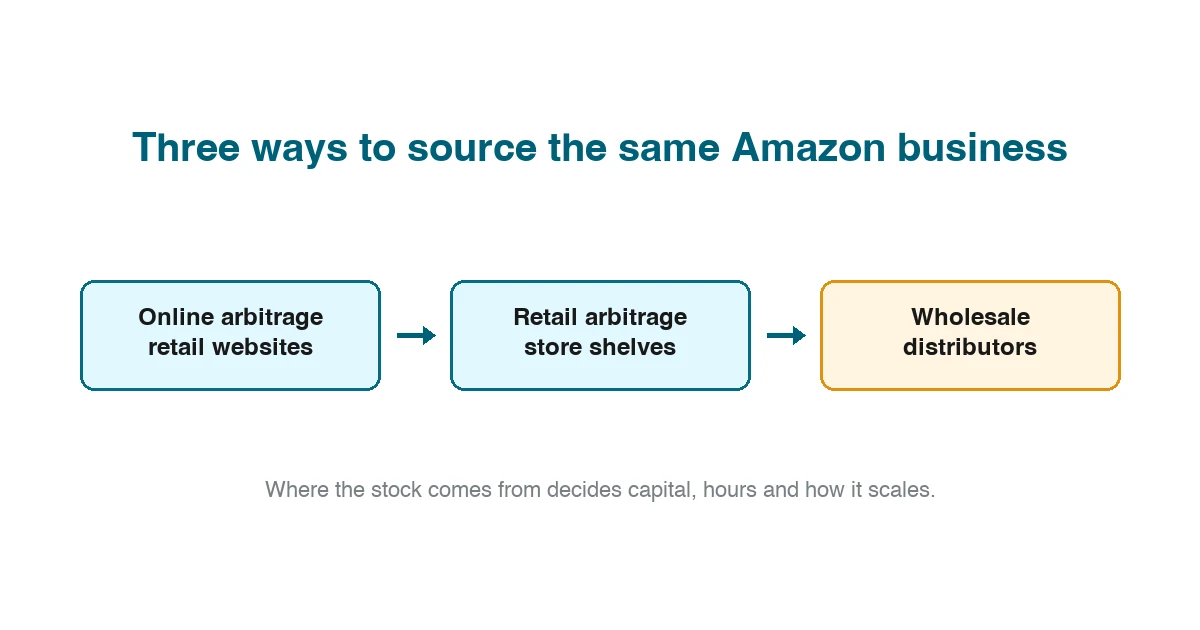
Short answer: all three models resell genuine products on Amazon; they differ in where the stock comes from. Online arbitrage buys from retail websites, retail arbitrage buys from physical store shelves, wholesale buys from distributors at bulk prices. That one difference drives everything else: starting capital, time per deal, how each model scales, and which risks you carry.
Sellers rarely stay in one box - the usual path runs from arbitrage into wholesale as capital grows, and plenty of sellers run two models at once. But the models reward different situations, so the useful question is not which is best in general. It is which fits the capital, time and appetite for paperwork you have right now.
How do the three models compare at a glance?
| Online arbitrage | Retail arbitrage | Wholesale | |
|---|---|---|---|
| Where you buy | Retail websites | Physical store shelves | Distributors and brands |
| Typical starting capital | A few hundred dollars | A few hundred dollars | Thousands: minimum order quantities |
| Where the work happens | At a desk, any hours | In stores, store hours | Email, phone, spreadsheets |
| Buying single units to test | Yes | Yes | Rarely: MOQs apply |
| Repeatable purchases | Sometimes: deals expire | Rarely: clearance is one-off | Yes: reorder the same list |
| Paperwork needed | Retail receipts | Retail receipts | Reseller accounts, invoices |
| What limits growth | Deal supply and capital | Your hours and local stores | Capital and supplier access |
What is online arbitrage in this picture?
Buying from retail websites at prices low enough to profit on Amazon after fees. The full model has its own explainer; what matters for this comparison is its shape. The hunt happens at a desk and at any hour, single units are buyable, and the ceiling on volume is how many price gaps you can find and fund - which is why sellers at scale lean on sourcing software to check thousands of products instead of dozens.
Its weakness is repeatability. A clearance price is temporary by definition, so last month's winning product is usually gone and the hunt starts again. Some products do restock at sourceable prices - the replenishable corner of the model, covered in our guide to choosing replenishable products - but the default is a treadmill of new deals.
What does retail arbitrage do differently?
The same economics, hunted on foot. You walk store aisles, scan shelf labels with a phone, and buy what clears the margin bar. Two things online sourcing cannot replicate work in its favour: in-store clearance prices are often deeper than the same chain shows online, and stock you are holding in your hands cannot be bought out from under you by a faster seller.
The costs are structural. Your range is the stores you can drive to, your sourcing hours are their opening hours, and none of it scales past your own legs - a second pair of hands means literally hiring one. Retail arbitrage rewards people who are near good stores and enjoy the treasure hunt; it punishes anyone trying to plan volume around it.
What makes wholesale a different animal?
The first two models buy at retail and profit from pricing mistakes. Wholesale buys at trade prices from distributors and profits from an ordinary trade margin - which changes the work entirely. You open reseller accounts, negotiate with suppliers, commit to minimum order quantities, and in exchange get the thing arbitrage cannot offer: a price list you can reorder from every month.
That repeatability is why sellers graduate toward wholesale as capital grows. The barriers are real, though: minimums put meaningful money at risk on products you have not sold before, suppliers vet who they sell to, and the per-unit margins are usually thinner than a good arbitrage flip - wholesale earns on volume and repetition, not on spectacular single gaps. The practical mechanics are in our guide to finding wholesale products, and analysing a supplier's price list against Amazon is exactly what a wholesale scanning tool automates.
Which model should a beginner start with?
Arbitrage, in either flavour, for one dominant reason: the cost of a lesson. An arbitrage mistake is one mispriced unit - a $15 tuition fee. A wholesale mistake is a minimum order of something that does not sell. Arbitrage also teaches the exact skills wholesale later needs - reading sales rank, judging demand, calculating margin after fees - on stakes a beginner can afford.
Between the two arbitrage flavours, it is mostly geography and temperament. Good clearance stores nearby and a liking for the hunt point to retail; no good stores nearby, or a preference for working from a desk at 11pm, points online. Plenty of sellers do both in the same week, and the Amazon side - prep, ship, price, sell - is identical regardless.
Can you combine the models?
Most sellers past their first year do, because the models cover each other's gaps. A common shape: wholesale lines supply the steady, reorderable base volume, and arbitrage supplies the high-margin opportunistic layer on top - especially in Q4, when retail discounting turns violent and arbitrage margins are at their fattest. The models also share infrastructure: the same seller account, the same prep process, the same repricing, the same fee arithmetic. Adding a second model is far cheaper than starting the first one was.
The bottom line
Where the stock comes from decides everything else. Buy from retail websites and you get low stakes, desk hours and a permanent hunt for new deals. Buy from store shelves and you trade scale for deeper discounts and local advantage. Buy from distributors and you trade higher stakes and paperwork for the only version of this business you can genuinely schedule. Start where the lessons are cheap; move up when repeatability is worth more to you than margin.