
Selling Supplements on Amazon: Easy to Source, Thin on Margin
 Max VershininFounder of Arbitrage Hero
supplementshealth and householdamazon fbareferral feesproduct sourcing
Ask AI to summarize this article:





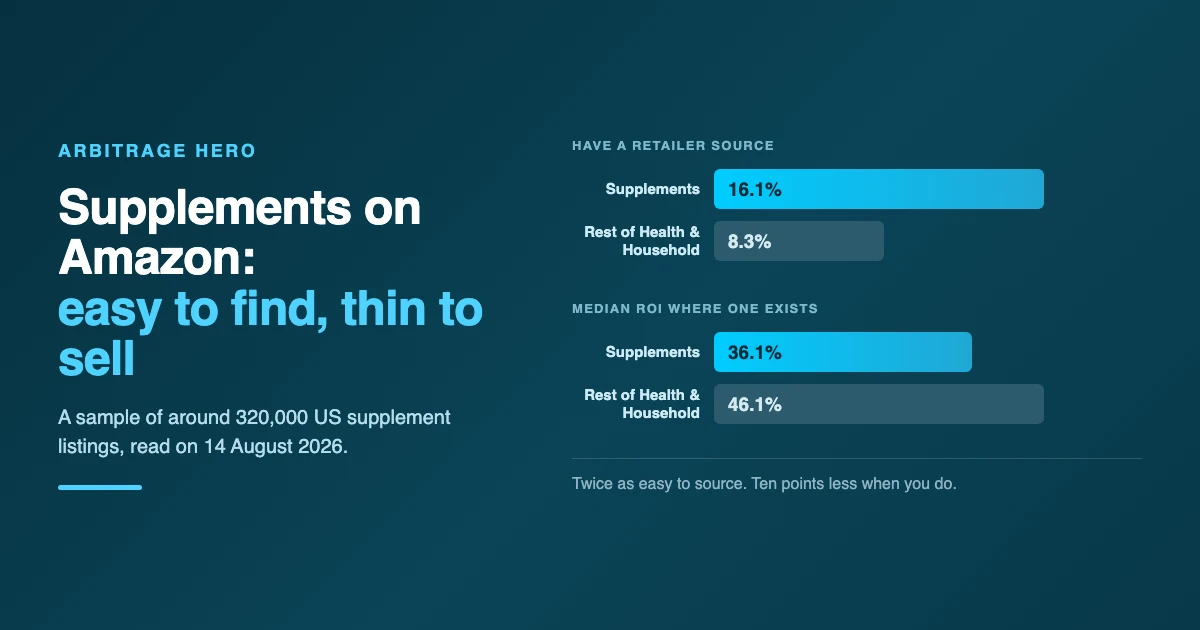
Short answer: yes, and supplements are one of the easiest parts of Amazon to find a retail source for. We reviewed a sample of around 320,000 US supplement listings in our own database on 14 August 2026. 16.1% of them have at least one tracked retailer selling the same product at a price we can calculate a return on, against 8.3% for the rest of Health and Household. The catch is the second number. Where a source exists, the median return on investment is 36.1%, against 46.1% for the rest of the category. Supplements are easy to find and crowded to sell.
Amazon publishes its own guide to this category, and the fullest public version is the British one, How to sell nutritional supplements on Amazon UK. It is a competent guide and it is written for a different person: somebody creating a brand, who has to register a food business, design a label, commission lab tests and buy barcodes. If you are buying finished supplements from a retailer and reselling them, almost none of that is your job. The parts that decide whether you make money are not in that guide at all. This article covers the four that do. What the category measures out at. Where the fees actually land. The compliance document that can close your listing when you have done nothing wrong. And the shelf life rule that can make a correctly calculated deal worthless after you have already paid for it.
Supplements are twice as easy to source and pay ten points less
The table below is the whole argument. Read the first two rows together: the thing that makes supplements attractive and the thing that makes them thin are the same thing.
| Measure | Supplements | Rest of Health and Household |
|---|---|---|
| Listings in the sample | around 320,000 | around 2.1 million |
| Share with a retailer source and a calculated ROI | 16.1% | 8.3% |
| Median ROI where a source exists | 36.1% | 46.1% |
| Share of those pairings at 30% ROI or better | 54.9% | 59.8% |
| Median Amazon selling price | $27.53 | $21.55 |
| Median Amazon fees on one sale | $8.14 | $7.85 |
| Fees as a share of the selling price | 31.6% | 39.3% |
| Share priced at $10.00 or less | 8.6% | 17.9% |
How this was counted, so you can judge it. The sample is the US Health and Household listings our own database holds, around 2.4 million of them, split by whether the product title contains a supplement word. The word list was vitamin, supplement, capsule, tablet, softgel, gummy, omega, magnesium, collagen, probiotic, creatine, whey, ashwagandha, turmeric, biotin, glucosamine, electrolyte, amino acid and protein powder. That leaves around 320,000 supplement listings. For scale, the Amazon category data we store puts roughly 450,000 products in the US Vitamins, Minerals and Supplements browse node, so the sample covers most of the category and misses some products whose title is only a brand name. A "retailer source" means at least one product at a retailer we scan has been matched to that listing and given an ROI figure. This is our own catalog and not Amazon's, so read the counts as a sample rather than a census. Both columns were measured the same way on the same day, including a few retailers we have since stopped scanning, so the ratio between them holds even where the absolute levels are a little generous.
Two rows in that table are good news and are worth separating from the rest. Supplements carry a lower fee burden than the rest of Health and Household, 31.6% of the selling price against 39.3%. They are light, they are small, and they sell at a higher price, which is exactly the combination Amazon's fee schedule rewards. The problem is not what Amazon charges. The problem is who else can find the same product.
The supply comes from discount supplement sites, and so does the thin margin
Here are the ten retailers we currently scan that produce the most supplement pairings in the US. The middle column is each retailer's share of the sourceable supplement listings in the sample, the 16.1% from the table above. One listing can have several retailers selling it, so the column does not add up to 100%. The pattern in the right-hand column is the point.
| Retailer | Share of sourceable listings | Median ROI |
|---|---|---|
| Target | 26.7% | 31.8% |
| Pure Formulas | 17.6% | 32.3% |
| Walmart | 16.5% | 50.7% |
| HerbsPro | 16.4% | 36.3% |
| VitaminLife | 16.2% | 38.8% |
| Swanson Vitamins | 12.9% | 39.3% |
| Vitacost | 10.2% | 23.4% |
| All Star Health | 9.5% | 29.7% |
| Piping Rock | 5.3% | 48.9% |
| Sears | 4.8% | 36.3% |
Most of that supply comes from sites that exist to sell supplements cheaply. That is why the pairings are so easy to find, and it is also why they pay less. A permanently discounted price is a price every other sourcing tool can see, so the gap between the retail price and the Amazon price is already small before anyone competes on it. The Vitamin Shoppe sits just outside the top ten at 4.6% of sourceable listings, with a median ROI of 22.5%, the lowest of the twelve retailers that supply the most supplement pairings in the sample.
The two best numbers in the table come from the opposite kind of source. Walmart at 50.7% is a general retailer where supplements are one shelf among thousands and the pricing is not built around this category. Piping Rock at 48.9% is a manufacturer selling its own brand direct. Neither is a supplement discounter competing with other supplement discounters. If you are sourcing this category, that is the shape to look for. You can see the full list of what we scan on the supported stores page.
Amazon takes about a third of the price, and there is a cliff at ten dollars
Amazon's published US fee schedule puts supplements inside Beauty, Health and Personal Care: 8% referral fee on a total sales price of $10.00 or less, 15% above that, with a $0.30 minimum. Read that as a rate change rather than a band and you will misprice things, because the higher rate applies to the whole price, not to the part above $10.00.
| You sell at | Referral fee | You keep |
|---|---|---|
| $10.00 | $0.80 at 8% | $9.20 |
| $10.01 | $1.50 at 15% | $8.51 |
| $10.82 | $1.62 at 15% | $9.20 |
One cent of extra price costs 69 cents of revenue, and you do not get back to where you were until $10.82. Every price between $10.01 and $10.82 earns you less than $10.00 does. About 0.4% of the supplement listings we hold a price for are sitting in that band right now. It is a small share because most supplements are nowhere near it: the median is $27.53 and only 8.6% are priced at $10.00 or under. It matters when you set the price yourself, and it matters most if a repricer is allowed to move a $9.99 item upward without knowing the rule.
One warning about reading British advice on American fees. Amazon cut the UK and European referral fee for Vitamins, Minerals and Supplements from 8% to 5% for items up to ten pounds or euros, effective 5 January 2026. The United States did not get that cut. The worked example in Amazon's British guide charges 5% on a ten pound sale; the same sale on Amazon.com is charged 8%. Our fuller breakdown of what Amazon deducts is in Amazon FBA fees in 2026, and the FBA calculator does the arithmetic on a specific product.
The document that keeps your listing open belongs to somebody else
This is the part of supplement selling that has no equivalent in most categories, and it is the reason to read past the fee tables.
Start with the legal background, because it explains why Amazon behaves the way it does. The US Food and Drug Administration does not approve dietary supplements before they go on sale. Under the Dietary Supplement Health and Education Act the manufacturer carries responsibility for safety, manufacturing practice and truthful labeling, and the FDA acts afterwards. The FDA's own dietary supplements pages set out that framework, including the manufacturing rules in 21 CFR part 111 and the disclaimer that has to appear with a structure or function claim: "This statement has not been evaluated by the Food and Drug Administration. This product is not intended to diagnose, treat, cure, or prevent any disease."
Amazon fills that gap with its own testing rule. Since April 2024 its dietary supplements policy has required each supplement product to be tested by an accredited laboratory connected to Amazon, arranged through the Manage Your Compliance dashboard in Seller Central. The important detail, reported when the policy landed by the trade press covering the sector, is that a seller can no longer send a certificate of analysis to Amazon directly. The laboratory sends the result to Amazon. Listings without one are suppressed.
Now the consequence for a reseller, which is what makes this different from ungating. The testing obligation attaches to the product, and the compliance labs and agencies that run these tests describe the same practice: it is discharged by whoever owns the listing, and other sellers then attach to a cleared listing and inherit that clearance without doing anything. That sounds like a gift, and for as long as it holds it is one. It also means the paperwork that keeps your offer alive is not paperwork you control. If the brand stops responding to Amazon, or misses a deadline on a document you have never seen, the listing can be suppressed. A suppressed listing takes down every offer on it at once, including yours, and the units you already sent to a fulfillment center stay there unsellable until it comes back. There is no application you can file to fix it, because the requirement was never yours. Check the Manage Your Compliance dashboard in your own Seller Central for what Amazon is asking of the products you sell.
That risk is not evenly spread. A supplement from a large brand with a compliance team is a different proposition from a supplement from a small brand that appeared eighteen months ago, even when the two show the same ROI on the same screen. Sales history is the practical proxy: a listing that has been selling steadily for two years has survived at least one round of this.
A supplement with four months left on it is not a deal
Supplements carry expiry dates, and Amazon treats expiry dated stock under a separate set of FBA rules. The authoritative page is in Seller Central and needs a login, so what follows is the version of the rules that Amazon's prep and compliance partners publish, checked on 14 August 2026. Three requirements come up in all of them. The unit needs more than 90 days of shelf life left when the fulfillment center receives it. The expiry date has to be printed on the individual unit and on the shipping carton. Anything that comes within 50 days of its date is disposed of rather than returned to you. Amazon revises these rules and the page sits behind a Seller Central login, so read the current version in your own account before you buy. Two things follow for sourcing.
First, the date has to clear the calendar, not just the check-in. Stock that arrives with four months on it will be disposed of at around two and a half months if it has not sold, and you get nothing back. On a slow moving supplement that is the likely outcome rather than the unlucky one.
Second, cheap supplements are cheap for a reason more often here than in other categories. Clearance pricing on a consumable is frequently a short date, and a retailer's website will not tell you what that date is. This is the one category where the ROI number on the screen can be completely correct and the deal still be worthless, and no sourcing tool can see it for you. It is checkable on arrival and not before, which is an argument for a small first order on any supplement you have not bought previously.
What to do with this
- Do not scan supplements the way you scan the rest of Health and Household. The category returns roughly twice as many pairings, so a filter that works elsewhere will bury you in low margin results here. Raise the ROI floor for this category specifically rather than working through the list.
- Weight your sourcing towards general retailers and direct manufacturers. Walmart at 50.7% and Piping Rock at 48.9% beat the supplement specialists by roughly twenty points of median ROI, for the plain reason that a site built to discount supplements has already given the margin away.
- Check the sales history before the profit figure. A steady two year selling record is the cheapest available evidence that the listing has survived Amazon's compliance sweeps and that the stock will move before its expiry date matters.
- Buy a small first order of anything consumable. The expiry date is the one input you cannot see until the box arrives, and it can turn a correct ROI calculation into a write-off.
- Watch the $10.00 line if you set your own prices. Below it the referral fee is 8%, above it 15% on the whole price, and nothing you can sell between $10.01 and $10.82 pays better than $10.00.
Frequently asked questions
Do you need Amazon's approval to sell supplements?
Often yes, and it depends on your account rather than on the product alone. Health and Household is one of the categories Amazon restricts, so some sellers are asked to apply before they can list while others are not. The application is normally decided on invoices from a distributor or the manufacturer, dated within the last 180 days and covering at least ten units, the figures Amazon's own category guides use and which we quote in full in how to get ungated. A receipt from a retail shop does not satisfy it, which is the awkward part for anyone sourcing at retail. Check each product from your own Seller Central rather than trusting a general list.
Is selling supplements on Amazon profitable for resellers?
It can be, but it pays less than the rest of Health and Household on our numbers. Across a sample of around 320,000 US supplement listings measured on 14 August 2026, the median ROI where a retailer source exists is 36.1%, against 46.1% for the rest of the category, and 54.9% of pairings reach 30% ROI or better. Fees are a smaller share of the price than in the rest of the category, at 31.6% against 39.3%. The category rewards selective sourcing rather than volume, because the easy pairings are the ones everybody else has already found.
What is Amazon's referral fee on supplements in the US?
Supplements sit inside Beauty, Health and Personal Care on Amazon's US fee schedule, which charges 8% of the total sales price on items at $10.00 or less and 15% above that, with a minimum of $0.30. The higher rate applies to the entire price rather than to the amount over $10.00, so an item at $10.01 pays $1.50 where an item at $10.00 pays $0.80. Amazon cut the equivalent British and European rate to 5% under ten pounds in January 2026, but that reduction does not apply in the United States.
Can you resell supplements bought from Walmart, Target or Vitacost?
Physically yes, and those three are among the largest sources of supplement pairings in our data. Two conditions decide whether it works. Your seller account has to be allowed to list the product, which is an account level question you can only answer from your own Seller Central. The units also have to satisfy Amazon's FBA rules for expiry dated stock, which a retail website will not tell you about in advance. Retail receipts do not open a restricted category, so buying at retail does not solve the first condition.
Why do supplement listings get suppressed on Amazon?
The usual reason is Amazon's dietary supplements testing policy, in force since April 2024. Each supplement product has to be tested by a laboratory connected to Amazon, arranged through the Manage Your Compliance dashboard, and the laboratory sends the result to Amazon directly rather than the seller sending a certificate. The obligation falls on whoever owns the listing. If that party misses a deadline the listing can be suppressed, and a suppressed listing takes down every offer on it at the same time, including offers from sellers who simply attached to a listing that was compliant when they bought their stock.
Keep reading
- Where Amazon arbitrage margins are thinnest, for how supplements compare against every other category on the same measurement.
- How to get ungated on Amazon, for the invoice that decides a restricted category application and why a retail receipt never does.
- Amazon FBA fees in 2026, for the seven deductions that sit between the sale price and what reaches your account.
- Which Amazon categories have profitable arbitrage deals, for choosing where to point a scan in the first place.
- What is online arbitrage, if the sourcing model itself is new to you.
- Our online arbitrage sourcing tool, for what a scan reports on each match, including eligibility next to profit.