
How to Get Ungated on Amazon: The Invoice That Decides It
 Max VershininFounder of Arbitrage Hero
ungatinggated categoriesamazon fbaselling approvalinvoices
Ask AI to summarize this article:





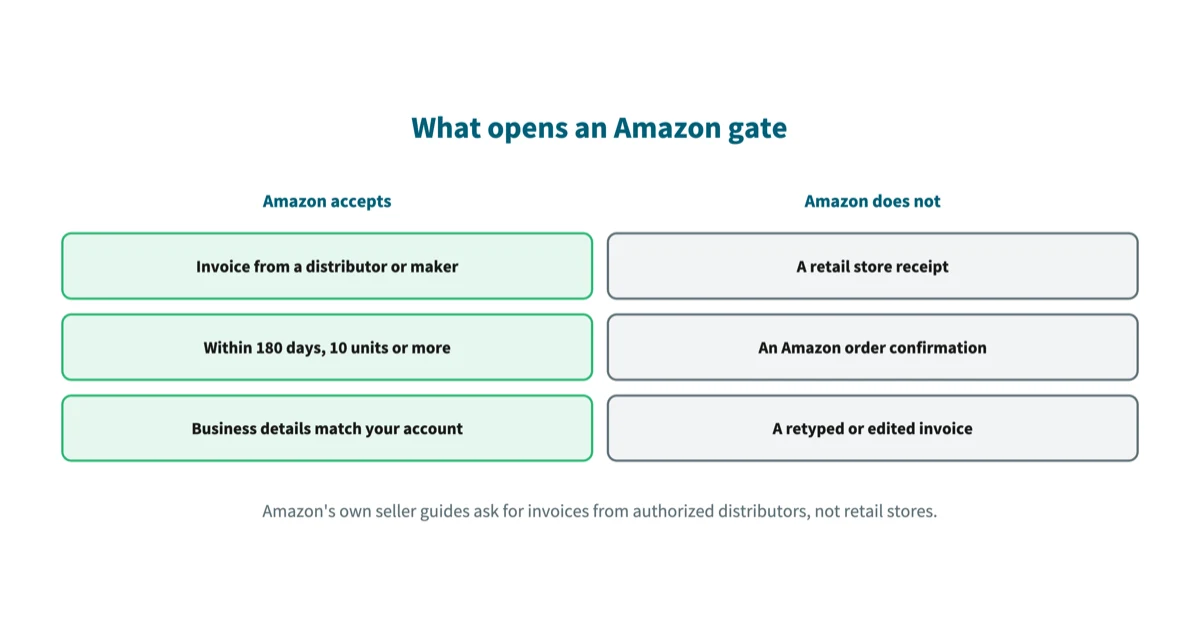
Short answer: you apply in Seller Central under Catalog, Add products, then the Apply to sell button on the product. The application is decided by the documents you attach. Where a form asks for documents, what it usually asks for is a purchase invoice from a distributor or the manufacturer. Amazon's own category guides ask for one dated within the last 180 days, covering at least 10 units, with a business name and address that match your seller account. The exact requirement depends on the product, the brand and the marketplace, but the source of the invoice does not move. A receipt from a retail store is not accepted, which is why buying at retail alone rarely opens a gate.
Most guides stop at "submit an invoice". For an online arbitrage seller that sentence hides the whole problem: your buying happens at retail websites, and Amazon's own seller guides ask for invoices from distributors and specifically not from retail stores. This article covers what the documents have to show, where the application lives, why a receipt fails, and an order of checks that lowers the chance of buying stock you are not allowed to list.
Eligibility differs from one seller account to the next
Restrictions attach to a selling account, not only to a product. Two sellers can open the same product page on the same day and see different answers: one can list it, the other is asked to apply first. Nothing you read anywhere else settles the question for you.
One practical consequence follows, and it is the whole reason this section exists. A screenshot in a course, a video, or an article proves nothing about your account, so check each product from your own Seller Central before you treat it as sourceable. A restriction you meet today may also not be permanent, so it is worth re-checking a category you gave up on months ago. The gated category entry in our glossary is the one-paragraph version of this.
What Amazon asks you to send
Requirements differ by category, and the heavily regulated ones ask for far more than an invoice. One line repeats across Amazon's own seller guides, though, and it is the line that matters most to an arbitrage seller: the invoice has to come from a distributor or the manufacturer, and it has to be recent.
| Category | What Amazon's own guide asks for |
|---|---|
| Beauty | Manufacturer invoices dated within 180 days, showing purchase of at least 10 units from authorized distributors, not retail stores. Plus product photos showing front, back, ingredient list and batch number, a Good Manufacturing Practices certificate, a Certificate of Analysis, and MoCRA compliance documentation. |
| Health and personal care | Manufacturer invoices dated within 180 days showing the purchase of at least 10 units from authorized distributors. Plus brand authorization letters, product photos, safety certifications, FDA documentation, and a business license. |
| Grocery | Copies of invoices showing the purchase of 10 or more units, a brand authorization letter permitting you to sell the brand's products, and compliance documentation from government bodies such as the FDA or the USDA. |
Those three rows are quoted from Amazon's own seller guides: how to sell beauty products, how to sell health and personal care products, and how to sell groceries in the Amazon store. They were checked on 11 August 2026. Amazon changes these requirements, they differ between marketplaces, and an individual brand can ask for more than its category does, so read the application form in front of you rather than a list from a blog, including this one.
Why a retail receipt does not open a gate
The document Amazon asks for is a supply chain trace, not a proof of payment. It is meant to show where the goods came from before they reached you. A receipt from a shop shows that you paid a shop; it says nothing about who made the product or who supplied that shop, so it cannot answer the question the application is asking.
That is why Amazon's beauty guide names the exclusion in the same sentence as the requirement: invoices "from authorized distributors, not retail stores". An order confirmation from another Amazon seller has the same problem, and so does a screenshot of a basket. For a seller whose whole model is buying from retail websites, this is the uncomfortable part: arbitrage buying does not produce the document that opens a gate. The usual route is one small wholesale order placed for exactly that purpose, from a distributor who will invoice you properly. That is what our wholesale sourcing page is about, and it is a different model from arbitrage rather than a step inside it.
One thing not to do: never retype, reformat or edit an invoice before sending it, even to tidy it up or to hide what you paid. Amazon's guides say pricing information may be omitted by the supplier, so ask the supplier for the version you need rather than producing it yourself. A document you cannot explain to Amazon puts the selling account at risk, and the account is worth more than any single category.
Where the application lives
Amazon's grocery guide gives the path, and it is the same one for other categories:
- In Seller Central, open Catalog, then Add products.
- Search for the product you want to sell.
- Select Apply to sell on it, which starts the approval process and shows you what that product wants from you.
- Attach the documents and submit.
- To see where an application stands, open Catalog and then View Selling Applications.
The form itself is the only authority on what your account needs for that product. Two sellers applying for the same brand can be asked for different things, and the same seller can be asked for more in one marketplace than in another.
What to do with this
- Check eligibility before you pay, not after the box arrives. A product you are not allowed to list is not a deal: it is stock you have to return, sell somewhere else, or sit on. Sourcing tools run this check on every result for that reason, ours included: eligibility sits next to profit, fees and sales history on each match, so the answer arrives before the money leaves. See the online arbitrage page for what a scan reports.
- Decide whether the category is worth a wholesale order. Ungating deliberately is a normal move: sellers buy a small lot from a distributor precisely to open a category they intend to source in for months. Weigh the cost of that lot against how much of your sourcing the gate is blocking.
- Ask the distributor for an invoice, not an order confirmation or a proforma. Then read it against four things: their business details, your business details as your seller account has them, the date, and the unit count.
- Submit once, complete. Attach everything the form asks for in a single application. An incomplete submission invites a request for more information, and a resubmission after a rejection is slower than getting it right the first time.
- Keep every invoice. The same document that opens the gate is what you need later if a brand challenges your listing, which is a separate problem with the same paperwork.
Frequently asked questions
How long does ungating take?
It depends on the category and on whether documents are needed at all. Where a gate opens automatically, approval is immediate. Where documents are required, Amazon's beauty guide says the process typically takes 1 to 5 business days once all required documents are submitted. Its health and personal care guide is vaguer: review time varies with the product type, the completeness of your documentation and the regulatory requirements involved. The completeness is the part you control.
Can I get ungated without buying wholesale?
Sometimes. Not every restriction asks for documents: some open as an account ages and performs, and some products only need an application. But when the form does ask for an invoice, it asks for one from a distributor or the manufacturer, so there is no version of that document you can obtain by shopping at retail. If a category matters to your sourcing and it wants an invoice, a small wholesale purchase is the route.
Do ungating services work?
Some sell you help with the paperwork, which is legitimate but is work you can do yourself. Others sell an invoice for goods you never bought, and that is a different thing entirely: the application is a statement to Amazon about where your stock came from, and one you cannot explain puts the account at risk, not just the category. If a service will not tell you which supplier the invoice comes from and what you are actually buying from them, that answer is the answer.
Does one approval cover other brands and marketplaces?
Treat it as covering only what you applied for. Approval is granted against a specific application, so a different brand inside the same category can still ask for its own, and another marketplace can ask again with its own restrictions and its own paperwork. Amazon may accept the same invoice for more than one application while it still meets the requirements shown on each form, so it is worth applying for everything a single order supports at the same time rather than months apart. Check each form before relying on that.
Keep reading
- What is ungating? The short definition, if you want the summary rather than the procedure.
- What is a gated category? Which categories are commonly restricted and why brands gate themselves.
- Online arbitrage vs retail arbitrage vs wholesale. Since the invoice comes from the wholesale model, this is what you are stepping into when you place that first distributor order.
- 10 beginner mistakes in online arbitrage. Buying before checking eligibility is one of them, and it is the expensive one.
- Hazmat products, flagged before you buy. Gating is not the only restriction that can stop a listing after the stock has arrived.