
· Updated
Is Online Arbitrage Still Worth It in 2026? An Honest Look
 Max VershininFounder of Arbitrage Hero
Ask AI to summarize this article:





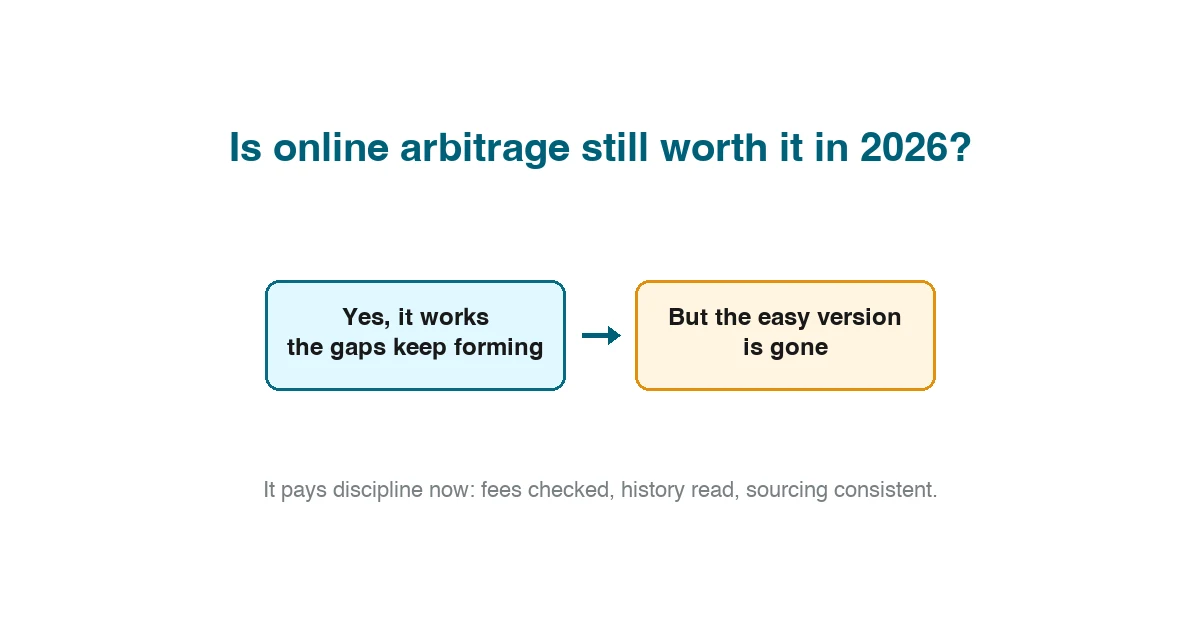
Short answer: yes, online arbitrage still works in 2026 - but the effortless version of it is gone. The model pays people who treat it as a numbers discipline: check fees before buying, read price history instead of trusting today's gap, and put in consistent sourcing hours. It no longer pays people hoping to skim easy margins off obvious deals, because the obvious deals now have too many people standing around them.
That is a different answer from "yes, it's great" and from "no, it's saturated" - the two you will find shouted at each other in every seller forum. Both camps are describing something real. This article separates what actually got harder from what still works, so you can decide from the mechanics rather than the mood.
What has genuinely gotten harder?
Three things, and it is worth being specific rather than waving at "competition":
- Fees take a bigger, more conditional bite. Amazon's fee structure has grown teeth in places it did not have them: a low-inventory fee, an aged-inventory surcharge, returns processing on high-return products. A margin calculated on referral and fulfilment alone can be wrong by the whole profit. The full picture is in our 2026 fee breakdown - the point here is that fee arithmetic is now the difference between the two camps in the forums.
- Obvious deals die faster. More sellers run more tooling, so a clearance gap on a popular product gets found, bought and competed flat in days rather than weeks. The sellers this hurts most are the ones sourcing from the same viral deal lists as everyone else - by the time a deal is famous, it is finished.
- Gating is stricter. More brands and categories require approval than five years ago, so "can I actually list this" is now a check that belongs before the purchase, not after the stock arrives.
What still works, and why does the model refuse to die?
The engine underneath is structural, not a loophole: retail prices and Amazon prices are set by different people with different goals, so gaps between them keep appearing. Every clearance cycle, every overstock, every regional promotion, every retailer that does not watch Amazon creates them. Competition changes who captures a gap - it does not stop gaps from forming.
Three ways sellers still capture them reliably in 2026:
- Breadth beats speed on famous deals. The seller checking hundreds of stores finds gaps that never make a deal list, and an unfamous gap lives long enough to profit from. This is the honest argument for sourcing software: not magic, just coverage a human cannot match by hand.
- Replenishables flatten the treadmill. Products that restock at sourceable prices turn one find into repeat purchases - the closest arbitrage gets to wholesale's repeatability. Our replenishables guide covers how to spot them.
- Seasonality still hands out margins. Q4 remains the season when retail discounting outruns Amazon repricing and gaps widen across whole categories - the Q4 guide is the practical version of this point.
What are the honest pros and cons in 2026?
| Pros | Cons |
|---|---|
| Lowest starting capital of any Amazon model: single units are buyable | Margins are earned per deal; nothing repeats by default |
| Desk work on your own hours: sourcing scales with attention, not geography | Fee mistakes silently eat profit; the arithmetic is on you |
| Sells on existing listings with existing demand: no audience-building | Price gaps close when others find them; famous deals die fast |
| Cheap lessons: a bad buy costs one unit, not a manufacturing run | Gating and IP complaints require checking before you buy |
| Skills transfer directly to wholesale when capital grows | Capital is tied up between buying and getting paid |
Who is online arbitrage still worth it for?
It fits three situations well. Someone starting on Amazon with a few hundred dollars, because no other model lets you learn on single-unit stakes - the case laid out in what online arbitrage is. A part-time seller who wants desk hours that flex around a job. And an established seller using arbitrage as the opportunistic, high-margin layer on top of steadier wholesale volume.
It fits badly if you need dependable income immediately - margins arrive deal by deal, and the learning weeks pay in lessons rather than cash. And it fits badly if checking numbers bores you, because in 2026 the checking is the job. The sellers who quit calling the model dead are, almost always, describing one of these two mismatches rather than the model.
How do you tilt the odds in 2026?
- Calculate every fee before every buy. Free and non-negotiable - the FBA calculator does it without a signup.
- Read history, not snapshots. A price gap against a spiked Amazon price, or demand that exists only in a rank snapshot, are the two classic ways to buy a dud. History charts kill both.
- Source where fewer people look. Wide store coverage, unfashionable categories, and your own filters rather than shared deal lists.
- Check eligibility before paying. Thirty seconds that prevents the worst outcome in the model - stock you cannot sell.
- Treat Q4 as the season it is. Plan stock and capital so the widest-margin quarter does not catch you empty.
The verdict
Online arbitrage in 2026 is a real, working model with a shrunken tolerance for sloppiness. The question that matters is not whether it still works - the price gaps demonstrably keep forming - but whether you will work it the way it now demands: numbers checked, history read, sourcing done consistently and slightly off the beaten path. If that sounds like a reasonable job description, the model will pay for the discipline. If it sounds like a chore, wholesale's spreadsheets will not feel any better.