
When To Stop Sending Stock Into Q4
 Max VershininFounder of Arbitrage Hero
q4fba storageinventory planningaged inventoryonline arbitrage
Ask AI to summarize this article:





Short answer: the question most sellers ask in September is "what is the last day I can send stock in". That date matters, and Amazon publishes it. But it is the smaller half of the decision. The larger half is per product: the last day a unit can arrive and still be sold before it starts costing more to keep than it will make. Those two dates are usually weeks apart, and the second one is the one that decides whether your Q4 was profitable or merely busy.
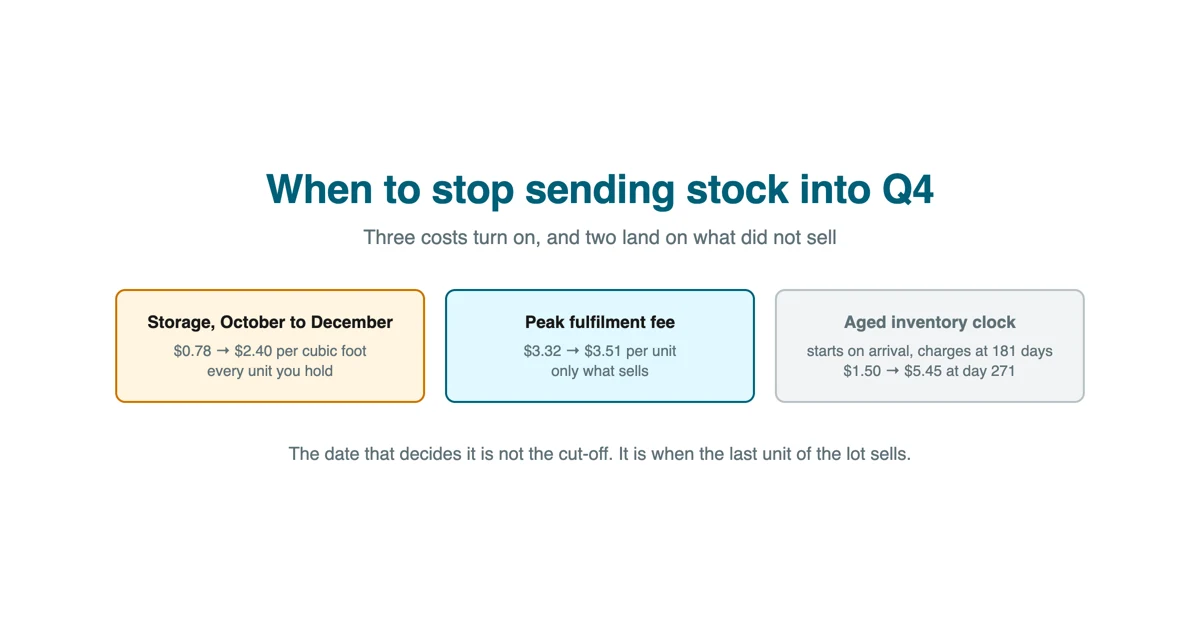
The reason is that three separate costs turn on in the fourth quarter, and they turn on for every unit you are holding, not for the ones that sell. A unit that sells on 8 December earns you the peak. The identical unit sitting next to it on 8 January is a different object entirely: it has paid three months of peak-rate storage, it is three months into its aged-inventory clock, and it now has to be sold in the quietest weeks of the retail year.
What actually changes in the fourth quarter
Three things, and only one of them gets discussed. All the figures below are the ones we read off Amazon's own fee pages for the 2026 fee breakdown.
| What changes | Effect | Who pays it |
|---|---|---|
| Monthly storage, October to December | Standard-size non-dangerous goods go from $0.78 to $2.40 per cubic foot, roughly three times | Every unit you are holding, whether or not it sells |
| Peak fulfilment fees, mid-October to mid-January | A small standard unit in the $10 to $50 band goes from $3.32 to $3.51 | Only units that sell, so this one is a good problem |
| The aged inventory clock | Starts on arrival, first charge at 181 days, and steps from $1.50 to $5.45 per cubic foot between 270 and 271 days | Anything that did not sell, with the bill arriving in spring |
Read those three rows as a sentence. The peak fulfilment increase is trivial and lands on your winners. The storage increase is not trivial and lands on everything. And the aged surcharge is the delayed consequence of an October decision, invoiced around April, by which time nobody connects the two.
The date that matters is the sell-through date, not the cut-off
Amazon's inbound deadlines tell you when a shipment must arrive to be available for the holiday. They are real and you should work to them. Our Q4 2026 deadlines post has them. But hitting the cut-off is a shipping question, and what you actually need is an answer to a different one: given how fast this product sells, when does the last unit in this lot leave the warehouse?
That is a division, and it needs one honest input: units sold per month for that ASIN, at your price, with the competition currently on the listing. If a product moves 15 units a month and you send 45, the last unit sells in three months. Send it in early November and the lot finishes in early February, which means a third of it pays peak storage and then sits through January.
| Units sent | Sells per month | Lot clears in | Sent 1 November, finishes |
|---|---|---|---|
| 20 | 20 | 1 month | Early December, entirely inside the peak |
| 45 | 15 | 3 months | Early February, a third of it after the season |
| 60 | 8 | 7.5 months | Mid June, and into the aged window |
Row three is the one to look at. Nothing is wrong with the deal itself; the return per unit may be excellent. What is wrong is the quantity against the velocity. Seven and a half months of stock bought at Q4 prices pays peak storage for three of them and reaches 181 days before it clears.
So when do you stop?
Work backwards from the last date you want the lot gone, not forward from the last date you can ship. Three questions, in this order.
- Does this product sell in January? This splits your catalogue in two and it is the single most useful question in the whole exercise. Consumables, replenishables and everyday household lines carry on selling on 3 January much as they did on 3 November. Gift-shaped products, decorations and anything seasonal fall off a cliff on 26 December and do not recover until next autumn.
- How many months of stock is this lot, at the rate this ASIN actually sells? Not at the rate you hope it will sell in December. If the answer is more than the number of months left in the season, you are buying January inventory, and you should decide that deliberately rather than discover it.
- What does the leftover cost to hold? Multiply the units you expect to have left by the storage rate for their size, for the months they will sit, and add the aged surcharge if that runs past 181 days from arrival. If that number is a meaningful share of the lot's profit, the lot is too big, not too late.
The rule that falls out of those three: for seasonal and gift-shaped products, stop sending when the lot can no longer clear before the end of December. For replenishable products, the seasonal deadline barely applies at all, and you should keep sending as long as the deal works, because January is an ordinary month for them and storage returns to its normal rate.
The mistake in the other direction
Everything above argues for restraint, so it is worth stating the opposite case plainly, because it is the more expensive error for most sellers. Running out of stock in the second week of December costs far more than storing a few leftover units into January.
A stockout in peak season loses the sales, and it also loses the position: the listing's momentum passes to whoever is still in stock, and buying it back in January is not cheap. Meanwhile the cost of being wrong in the other direction is arithmetic you can do in advance and it is usually small. Holding 20 leftover units of a product occupying a tenth of a cubic foot each, at the peak rate, is a couple of dollars a month. That is not a reason to under-buy a good product in the best selling weeks of the year.
So the asymmetry is: be generous on things that sell all year, and be strict on things that only sell in December. The cost of over-sending a replenishable line is a small storage bill. The cost of over-sending a Christmas line is a write-down in February.
What to do with what is left
Decide in January, not in April when the aged surcharge shows up. The 181-day mark for stock that arrived in October falls around the start of April, and the expensive step at 271 days lands in the summer. That gives a comfortable window to act, and the point is to use it rather than to let the calendar decide.
- Reprice early rather than deeply. A small reduction in January usually clears more units than a large one in March, because the aged clock is running the whole time and the discount is competing against your own storage bill.
- Count removal and disposal as real options. They cost money, and so does holding. Compare the removal fee against the storage plus surcharge for the months you would otherwise be paying.
- Note what actually happened for next year. Which lines cleared before Christmas, which did not, and what the real monthly velocity turned out to be. That figure is the input to next year's version of this decision, and it is the one nobody writes down.
The sourcing side of this is the same as it always is: buy things that sell steadily rather than things that look cheap. When you are scanning stores in Arbitrage Hero, sales velocity and rank stability are the fields that answer the January question, and they matter more in September than the return does.
Frequently asked questions
When should I stop sending inventory for Q4?
There is no single date, because it depends on the product. For gift-shaped and seasonal stock, stop when the lot can no longer clear before the end of December at that ASIN's real monthly sales rate, which for many sellers falls in the first half of November rather than at Amazon's cut-off. For replenishable products that sell all year, the seasonal deadline is close to irrelevant: keep sending while the deal works, because January is a normal month for them.
How much does Q4 storage actually cost?
Standard-size non-dangerous goods go from $0.78 per cubic foot to $2.40 for October, November and December, so roughly three times the rate. On a unit occupying a tenth of a cubic foot that is about 24 cents a month rather than 8. Per unit it is small, which is why it gets ignored, and across a few hundred units of slow stock held for three months it stops being small.
Is it worse to run out of stock or to have leftovers?
Running out is usually worse, and by a wide margin. A stockout in December loses the sales at the highest-demand moment of the year and hands the listing's momentum to a competitor who is still in stock, which is expensive to win back. Leftovers cost a calculable storage bill and a repricing decision in January. Be generous with products that sell all year, and strict with products that only sell in December.
When does the aged inventory surcharge hit Q4 stock?
The clock starts when the unit arrives at the fulfilment centre, and the first charge lands at 181 days. Stock that arrived in October therefore reaches that mark around the start of April, and the expensive step, where the rate goes from $1.50 to $5.45 per cubic foot, arrives around the following July. January is the month to act on leftovers, because it is early enough that a modest price reduction is still cheaper than the alternatives.
Keep reading
- Amazon FBA Q4 2026 deadlines has the inbound dates this decision is measured against.
- The Q4 online arbitrage guide covers the season end to end, from sourcing through to the January clean-up.
- Best categories and stores for Q4 sourcing is where the January question gets answered by category.
- Amazon FBA fees in 2026 is the source of every figure quoted here.
- Choosing replenishable products is the long answer to why the two halves of your catalogue behave so differently in January.