
How to Resell on Amazon in 2026: Steps, Rules and Fees
 Max VershininFounder of Arbitrage Hero
resellingretail arbitrageonline arbitragefba feesamazon barcodes
Ask AI to summarize this article:





How to resell on Amazon in 2026: open a seller account, check that you may sell the product, buy genuine stock and keep the purchase records, and add your offer to the existing product page. Then send the units to Amazon's warehouses with an Amazon barcode on each one, which Amazon US requires of every reseller since 31 March 2026, or ship orders yourself. Before you buy, compare Amazon's selling and fulfillment fees with your buy price, shipping and other costs.
This guide gives each step with the rule that applies on 10 November 2026, for Amazon US and Amazon UK. It also quotes a conflict about liquidation stock in Amazon's own reselling guide, and works through one fee example at the 2026 peak rates. Arbitrage Hero, the software behind this blog, does the fee check for online arbitrage and wholesale. It scans 430 US and UK stores against Amazon and shows the profit, fees and ROI of each match.
How to resell on Amazon: you add your offer to a listing that already exists
A reseller sells products that are already in Amazon's catalogue, so you do not build a product page. Amazon UK's reseller page says: "Reselling means selling products that are already listed in the Amazon catalogue." You match your stock to that page, set your price and choose who ships the order.
Amazon's guide to reselling, dated 17 September 2025, describes three ways to get the stock:
- Retail arbitrage: "purchasing products from retail stores at lower prices and reselling them for a profit". Online arbitrage is the same idea with online stores.
- Wholesale: buying from manufacturers or wholesale distributors.
- Used goods and collectibles: thrift stores, estate sales and private sellers, listed in one of four used conditions.
Step 1: Choose the Individual or the Professional selling plan
On Amazon US, the Individual plan costs $0.99 per item sold and the Professional plan costs $39.99 a month, according to Amazon's pricing page. Both plans also pay selling fees. On Amazon UK, the Individual plan costs £0.75 per unit sold and the Professional plan £25 a month before VAT, according to Amazon UK's reseller page.
The plans differ in tools as well as in price. On the US pricing page, both plans can list one product at a time, set static prices, and use Fulfillment by Amazon (FBA) or ship orders themselves. Only the Professional plan has bulk listing, Amazon Ads and Automate Pricing. Amazon UK's reseller page describes Automate Pricing as a tool that adjusts your prices "automatically within limits you set". The prices in the table cover both marketplaces; the tool rows come from the US pricing page.
| Individual | Professional | |
|---|---|---|
| Amazon US | $0.99 per item sold | $39.99 a month |
| Amazon UK | £0.75 per unit sold | £25 a month before VAT |
| Amazon US: FBA or own shipping | yes | yes |
| Amazon US: bulk listing and Automate Pricing | no | yes |
On Amazon US, the Professional fee is lower than the per-item fees from 41 items a month: 41 x $0.99 = $40.59, which is more than $39.99. Amazon's pricing page says you can switch or cancel the plan at any time after registration.
Step 2: Check selling approval and keep purchase documents
Before you buy stock, check that your account may sell the product, and keep a document of every purchase. For a beginner, we recommend sources that give an invoice, although Amazon's guide does not say that every resale needs one. Amazon's reselling guide tells resellers to "keep documentation and records of transactions, such as purchase orders and invoices". It also says that a product bought from a retailer "might need additional documents, such as invoices".
Some products need Amazon's approval before you can list them. Amazon UK's reseller page names three levels of access:
- Open categories, such as Home & Kitchen, Sports and Garden: any seller can list.
- Gated categories, such as Grocery, Health & Beauty and Automotive: approval first.
- Restricted brands: the brand's authorisation first.
For a gated category, the UK page says you will typically need invoices from an authorised distributor, dated within the last 180 days, with at least 10 units per invoice and the supplier's business name and contact details clearly visible.
Amazon's reselling guide says two things about liquidation
Amazon's US reselling guide recommends liquidation stock as a source in several places, and a note on the same page says it is not a valid source. In the text, the guide says to "source products from thrift stores, estate sales, online liquidation sites, and private sellers". For growth, it suggests "wholesale distributors or online liquidation sites". The note under its video "Guidelines for sourcing products" says: "Drop-shipping retail-to-retail is prohibited; auctions and liquidation are not valid sources of supply."
The page does not say which statement applies when they conflict. Our recommendation for a new seller is to avoid liquidation and auction stock, because the note calls it "not valid sources of supply". An invoice from a liquidation seller does not settle that question. The Arbitrage Hero Academy lesson on liquidations also cautions new sellers against liquidation, and adds that liquidation lots "frequently come with no usable documentation".
Step 3: Check the fees before you buy
Work out what Amazon keeps before you pay for a product. The fee check for one example, estimated with the rates of the peak period from 15 October 2026 to 14 January 2027:
- The product: a toy sold for $24.99 on Amazon US, in a 7 x 4 x 0.75 inch pack that weighs 6 ounces. That pack is in the small standard size tier.
- The referral fee: Toys and Games pays 15% of the total price, minimum $0.30, on Amazon's pricing page. 15% of $24.99 is $3.75.
- The FBA fulfillment fee: $3.65 in Amazon's FBA fulfillment fee table (small standard, over 4 ounces up to 6 ounces, price $10 to $50). Since 17 April 2026, Amazon adds a fuel and logistics surcharge of 3.5% of the fulfillment fee, so the fee is $3.65 x 1.035 = $3.78.
- Amazon fees together: $7.53, about 30% of the price.
- What is left of this $24.99 Amazon US toy in the peak period: an estimated $17.46 on the Professional plan before its monthly fee, or $16.47 on the Individual plan after its $0.99 per item. Neither amount is profit: both leave out the buy price, inbound shipping, placement fees, storage, labels, returns and tax.
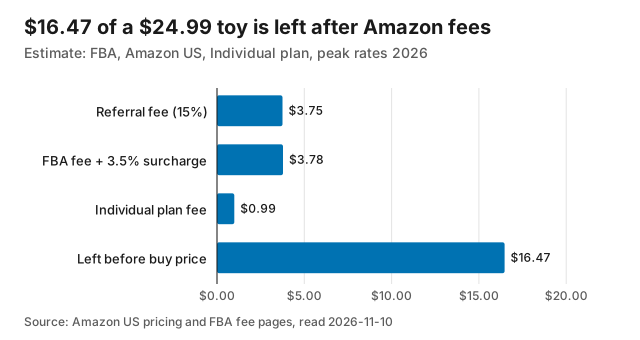
The chart shows the same split of the $24.99 price on the Individual plan. The example leaves out the buy price, the Professional plan's monthly fee, inbound shipping, the inbound placement fee, storage, labels, returns and tax. Each line is rounded on its own, so a total can differ from its parts by a cent. Your own product has its own category and size, so run it in the free FBA calculator. Arbitrage Hero takes the fees of every product it matches into the profit it shows.
The same toy after the peak period
The estimate changes when the peak period ends. Take the same $24.99 Toys and Games item on Amazon US, small standard, over 4 ounces up to 6 ounces. From 15 January 2027, Amazon's table gives a fulfillment fee of $3.92, or $4.06 with the surcharge of 3.5% of that fee. After the 15% referral fee, an estimated $17.18 is left on the Professional plan before its monthly fee, and $16.19 on the Individual plan after its $0.99 per item. Both amounts leave out the buy price, inbound shipping, placement fees, storage, labels, returns and tax.
Step 4: Add your offer to the existing product page
Find the product in Amazon's catalogue and add your offer to its page. Amazon UK's reseller page says: "You'll need the product's EAN, UPC, or ASIN to match accurately." Amazon's US guide describes the same thing: you "match products to listings that are already live".
When several sellers offer one product, one offer is shown first with the Buy Now button. Amazon calls it the Featured Offer, often called the Buy Box. The UK reseller page names three things that pick it:
- The price, including delivery.
- The fulfilment method. FBA offers "are weighted higher".
- Seller performance, such as order defect rate and late shipment rate.
You can change your price by hand on either plan. Amazon's reselling guide suggests trying its Automate Pricing tool, and the US pricing page lists that tool for the Professional plan only.
Step 5: Put an Amazon barcode on every unit you send to FBA
On Amazon US, since 31 March 2026, every reseller must put an Amazon barcode on each unit sent to Amazon's warehouses, even when the product has a manufacturer barcode. Amazon's FBA barcode FAQ says this applies to "all resellers, including authorized resellers". Only brand owners can keep using the manufacturer barcode without a sticker.
Amazon calls these barcodes "X00 labels" and says you can print and apply them yourself. Units that arrive without them "will be considered defective". Amazon tries to fix the label, and units that are not labeled as required are not eligible for reimbursement. Our guide to FNSKU labels for resellers shows where to print them and where to put them. It also has a section for sellers on Amazon UK.
You can also skip FBA and ship each order yourself. Then the label rule does not apply, but storage and postage are yours. Our comparison of FBA or FBM cost per unit works out where each one costs less.
What to do next
Before you buy stock to resell, choose a marketplace, confirm the product and the paperwork, and calculate the costs for the month it will sell.
- Choose retail arbitrage, online arbitrage, wholesale or used goods, and choose Amazon US or Amazon UK.
- Choose the plan from your expected sales a month. On Amazon US, the Professional plan costs less from 41 items a month.
- Before you buy, check that the product is not gated for your account, and that the seller will give you a purchase document. We recommend an invoice.
- Run the numbers for the exact product, with the fee period in which it will sell.
- On Amazon US, put an Amazon barcode on each unit before the first FBA shipment.
Is it legal to resell products on Amazon?
Yes, reselling genuine products on Amazon is allowed when you follow Amazon's rules, and Amazon's own reselling guide describes how to do it. The guide says retail arbitrage can work "if you follow Amazon selling guidelines", and that a reseller might need invoices to sell some products. A brand can still restrict who sells it on Amazon: Amazon UK's reseller page lists restricted brands that need the brand's authorisation. Trademark law is a separate question, and our article on whether online arbitrage is legal quotes the US case law and the UK Trade Marks Act. This guide is general information, not legal or tax advice.
Can you resell used items on Amazon?
Yes, Amazon lets resellers sell used items on an existing product page in one of four used conditions: Like New, Very Good, Good and Acceptable. Amazon's reselling guide lists these four tiers and tells sellers to "describe the product in your own words" and to add "high-quality photos that show the product from multiple angles". Some collectible categories need approval first: the guide names Collectible Coins, Entertainment Collectibles, Fine Art and Sports Collectibles. It also says that "purchase orders, invoices, and receipts can serve as proof of authenticity if questions come up".
Do you need a registered business to resell on Amazon UK?
On Amazon UK you need a registered business or sole-trader status to sell as a reseller, according to Amazon UK's reseller page. You also need a valid government ID, a bank account for payments and a card for the plan fee. The same page says you do not need a registered trademark, Brand Registry, product photos or a website, because you sell on product pages that already exist. For the fees you pay per sale on Amazon UK, read our guide to Amazon FBA fees in the UK.