
Amazon FBA vs FBM for online arbitrage: which costs less per unit in 2026?
 Max VershininFounder of Arbitrage Hero
fbafbmfba feesuspsonline arbitrage
Ask AI to summarize this article:





In this Amazon FBA vs FBM calculation for three hypothetical US units, the estimated FBA charges for one unit are lower than USPS Ground Advantage postage alone at Amazon's 2026 peak rates. For a 6 oz, a 2 lb and a 5 lb unit priced $10 to $50, the FBA fee with the 3.5% surcharge, inbound placement and one month of storage come to an estimated $3.95 to $10.03. Postage costs $7.33 to $20.24. The comparison leaves out FBA inbound shipping and prep, and FBM packaging and labor.
The FBA figures come from Amazon's 2026 US fee pages and the postage from the USPS price list in force since 4 October 2026, all read on 30 October 2026. Arbitrage Hero pulls Amazon's fees for every product it analyzes. Check which charges a result includes, and add your own inbound placement, inbound shipping, expected storage and, for FBM, postage.
Amazon FBA vs FBM: the cost lines of one unit
At the same buyer-paid total and category, FBA and FBM pay the same referral fee, and the fulfillment costs differ. FBA (Fulfillment by Amazon) means Amazon stores, packs and ships your units. FBM (fulfilled by merchant) means you keep the stock and post each order yourself. The cost of buying the stock and getting it to you is the same for both and is outside this comparison.
| Cost of one unit | FBA | FBM |
|---|---|---|
| Referral fee | A percentage of the total sales price | The same percentage, also on any shipping charge you add |
| Getting the unit to the buyer | Amazon's fulfillment fee plus a 3.5% surcharge on that fee | Your postage |
| Storage | Amazon's monthly fee per cubic foot | Your own space |
| Sending stock to Amazon | Inbound placement fee and the shipment to Amazon | Not needed |
| Seller's prep and packing work | Prep and labels before sending units to Amazon | Packing each customer order |
Amazon's 2026 US FBA fulfillment fee changes page sets the fulfillment fee by size tier, shipping weight and price band: under $10, $10 to $50, and over $50. The same page says that "Starting April 17, 2026, a 3.5% fuel and logistics-related surcharge will be applied to fulfillment fees" in the US, and that its rate tables do not include the surcharge. Holiday peak fees apply from 15 October 2026 to 14 January 2027, and the surcharge applies to them too.
Amazon's monthly inventory storage fees page charges standard-size items $0.78 per cubic foot a month from January to September and $2.40 from October to December, for sellers with 25 cubic feet of daily stock or less. Amazon's FBA inbound placement service fee page charges a fee per unit when you send a shipment to a single location. The Amazon-optimized shipment splits option has no fee, but needs at least five identical cartons or pallets per item.
What one unit costs by FBA and by FBM in three examples
In all three hypothetical examples, the estimated FBA fulfillment, placement and storage charges were lower than USPS postage alone at zones 1, 4 and 8, before the costs this comparison leaves out. The examples are hypothetical units that sell during the peak period from 15 October 2026 to 14 January 2027.
The inputs of the three examples
- Example A: a small standard-size unit of 6 oz in a 7 x 4 x 0.75 inch pack. Amazon uses the unit weight for this size tier.
- Example B: a large standard-size unit of 2 lb in a 10 x 6 x 3 inch box.
- Example C: a large standard-size unit of 5 lb in a 12 x 10 x 5 inch box.
All three are priced $10 to $50 and are not apparel or dangerous goods. For B and C, Amazon uses the greater of the unit weight and the dimensional weight; we picked boxes whose unit weight is the greater one. The FBA total adds the inbound placement fee for a single location (Amazon gives a range) and one month of storage at the October-to-December rate.
The FBM side is the USPS Ground Advantage commercial price from USPS Notice 123, effective 4 October 2026, for a parcel that weighs the same as the unit. This assumes the complete outbound parcel, with its box or mailer, stays within the stated weight. Examples B and C are exactly at the 2 lb and 5 lb limits, so if packaging adds weight, use the next USPS weight band.
The result for each example
- Example A: Amazon's peak fulfillment fee of $3.65 plus the 3.5% surcharge is $3.78. Amazon storage is 0.0122 cubic feet x $2.40 = $0.03 a month, and Amazon's placement fee is $0.14 to $0.32. The estimated FBA total is $3.95 to $4.13. USPS postage is $7.33 at zone 1, $7.86 at zone 4 and $8.95 at zone 8.
- Example B: Amazon's peak fulfillment fee of $6.15 plus the surcharge is $6.37. Amazon storage is 0.1042 cubic feet x $2.40 = $0.25 a month, and Amazon's placement fee is $0.34 to $0.60. The estimated FBA total is $6.96 to $7.22. USPS postage is $8.39 at zone 1, $8.91 at zone 4 and $13.42 at zone 8.
- Example C: Amazon's peak fulfillment fee is $7.51 plus $0.08 for each 4 oz above 3 lb, so $8.15, and $8.44 with the surcharge. Amazon storage is 0.3472 cubic feet x $2.40 = $0.83 a month, and Amazon's placement fee is $0.38 to $0.76. The estimated FBA total is $9.65 to $10.03. USPS postage is $10.35 at zone 1, $11.67 at zone 4 and $20.24 at zone 8.
The estimated FBA charges are below USPS postage in all three examples
For the three packs priced $10 to $50, with one month of October-to-December storage and the placement ranges above, the estimated peak FBA charges are below USPS postage alone at zones 1, 4 and 8.
| Example | FBA fee with the 3.5% surcharge | FBA total per unit (estimated) | FBM postage, zone 1 to zone 8 |
|---|---|---|---|
| A, 6 oz | $3.78 | $3.95 to $4.13 | $7.33 to $8.95 |
| B, 2 lb | $6.37 | $6.96 to $7.22 | $8.39 to $13.42 |
| C, 5 lb | $8.44 | $9.65 to $10.03 | $10.35 to $20.24 |
Each value is calculated from the unrounded inputs and rounded to the cent on its own, so a total can differ by a cent from the sum of rounded parts.
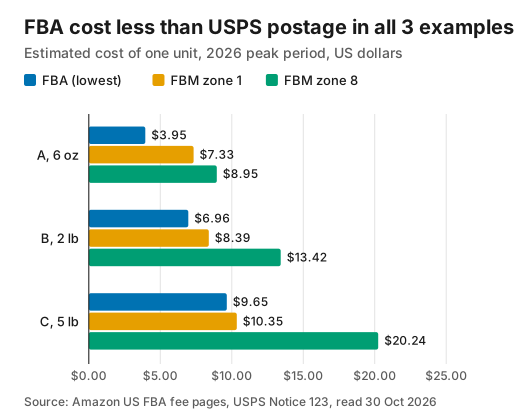
The chart shows the lowest FBA total of each example next to the zone 1 and zone 8 postage. In relative terms, the gap is largest for the 6 oz example: its zone 1 postage is almost twice its FBA total.
When does FBM cost less than FBA?
FBM can cost less than FBA per unit when a heavy unit waits long in Amazon storage. Our hypothetical 5 lb US unit is 12 x 10 x 5 inches and priced $10 to $50. Its estimated FBA charges pass USPS Ground Advantage postage after 1.4 to 1.8 months for zone 1 ($10.35) and 3.0 to 3.4 months for zone 4 ($11.67). The estimate holds the peak fulfillment fee with the 3.5% surcharge and the October-to-December storage rate constant, with the $0.38 to $0.76 placement fee. It leaves out FBA inbound shipping and prep, and FBM packaging, labor and storage: it is neither a calendar forecast nor a full cost.
The estimate uses one formula: months = (postage - fulfillment fee with surcharge - placement fee) / storage per month. For Example C that is ($10.35 - $8.44 - $0.38 to $0.76) / $0.83, with unrounded inputs. Holding storage at the October-to-December rate of $2.40 per cubic foot, the estimated FBA total for Example C is $10.48 to $10.86 after two months and $11.32 to $11.70 after three months. These are fixed-rate scenarios: a unit still in storage in January pays the $0.78 rate.
| Months in storage, October to December rate | Example C by FBA (estimated) | Example C by FBM, zone 1 / zone 4 / zone 8 |
|---|---|---|
| 1 | $9.65 to $10.03 | $10.35 / $11.67 / $20.24 |
| 2 | $10.48 to $10.86 | $10.35 / $11.67 / $20.24 |
| 3 | $11.32 to $11.70 | $10.35 / $11.67 / $20.24 |
Storage changes the result for the lighter examples much less. Example B adds an estimated $0.25 a month at the October-to-December base storage rate. For a stay that runs into January, calculate each month's storage at its own rate and use the fulfillment fee in force on the sale date. Example A adds an estimated $0.03 a month at that rate, which does not reverse the postage-only comparison over the one to three months modeled here; a longer stay needs its own calculation.
Does the referral fee change between FBA and FBM?
No, for the same product in the same category at the same buyer-paid total, the referral fee is the same for FBA and FBM, because Amazon calculates it on the total sales price whichever way you ship. Amazon's Selling on Amazon fee schedule says the total sales price is "the total amount paid by the buyer, including the item price and any delivery or gift wrapping charges."
So a shipping charge on an FBM offer pays the referral fee too. In a category with a 15% referral fee, such as Toys and Games, each $1.00 of shipping charge adds $0.15 of referral fee. The examples above leave the referral fee out for this reason: at the same total, it is the same for both methods.
What the comparison leaves out
The estimates include the FBA fulfillment, inbound placement and base storage charges, compared with USPS postage. They leave out the costs below, some of which have published rates. Each one adds to one side or to both.
- FBA: the shipment of your cartons to Amazon. Its price depends on the carrier and the carton.
- FBA: prep and labels on the units you send in, which our guide to FNSKU labels explains.
- FBA: the low-inventory-level fee. Amazon's rate card page says Amazon charges it "when inventory falls below 28 days of supply relative to customer demand".
- FBA: the storage utilization surcharge. It applies only to some sellers with 25 cubic feet of daily stock or more.
- FBM: the box or mailer, label printing, packing time, and any cost of storing the stock yourself.
- Both: returns, the selling plan fee, and the cost of buying the stock and getting it to you.
This guide compares cost only and does not measure how FBA or FBM changes how fast a unit sells. The Academy lesson on what FBA does for you covers the Prime badge and the work FBA takes over. If you ship orders yourself, also read Amazon's dropshipping rules for orders you ship yourself. The examples use US rates only; for the UK, see Amazon FBA fees in the UK. These estimates are general information, not financial or tax advice.
What to do next
Choose FBA or FBM for a deal only after you add your own unpriced costs to both sides of the published-rate sum.
- Measure the packaged unit and find its size tier and shipping weight on Amazon's rate card.
- Take the fulfillment fee for its price band and sale date, and add the 3.5% surcharge on that fee. Use the peak rates for sales up to 14 January 2027; for later sales, check the rate card in force on the expected sale date.
- Add the inbound placement fee, your inbound shipping and prep per unit, and the storage for the months you expect the unit to wait.
- On the FBM side, weigh the complete outbound parcel and add its postage for the zones you ship to most, plus packaging, your time and any storage cost per unit.
- Put both into Arbitrage Hero's free FBA calculator. For the FBM sum, enter 0 as the FBA fulfilment fee and your postage as the shipping cost.
Our guide to the 2026 US FBA fees lists the other fees a small seller pays.