
Which Barcode Do You Need to Sell on Amazon? UPC, GS1 and FNSKU
 Max VershininFounder of Arbitrage Hero
barcodesupcgs1fnskugtin exemption
Ask AI to summarize this article:





A reseller buys no barcodes for Amazon products that are already listed, because Amazon's ASIN creation policy lets you "add an offer to the existing ASIN". For FBA, Amazon's FBA barcode requirements have required resellers since March 31, 2026 to put an Amazon barcode, the FNSKU label, on every unit, even with a manufacturer barcode. A product not on Amazon yet needs a valid product ID, such as a UPC or EAN. For your own product without one, you license GS1 barcodes or apply for a GTIN exemption.
This guide is for sellers who buy products to resell, and for sellers who plan their own products. It is published by Arbitrage Hero, sourcing software for Amazon sellers. Arbitrage Hero matches store products to Amazon listings mainly by barcode, so the UPC or EAN printed on a store product is what leads you to the existing ASIN.
Buying a barcode for a listing and labeling an FBA unit are two different decisions. This guide separates them with Amazon's own help pages, read on November 24, 2026. It adds the cost of ten GS1 US barcodes over five years, calculated from GS1 US's price list.
Barcodes for Amazon products depend on whether the product is already listed
A seller who resells an existing product needs no barcode of their own, and a brand owner who creates a new product without a barcode needs a GS1 barcode or a GTIN exemption. On the FBA side, a reseller needs an Amazon barcode on every unit. Amazon lets qualifying brand-owner inventory keep the manufacturer barcode, and our FNSKU guide explains the conditions.
| Your case | Product ID for the listing | Barcode on each unit you send to FBA |
|---|---|---|
| You resell a product that is already on Amazon | None to buy: add an offer to the existing ASIN | Amazon barcode (FNSKU) |
| You are the brand owner of a new product | Your own GS1 UPC or EAN | Manufacturer barcode, if your brand-owner inventory qualifies; otherwise an Amazon barcode |
| Your own-brand product has no product ID and is not on Amazon | A GTIN exemption, if Amazon approves it (brands with GS1 barcodes are excluded) | Amazon barcode (FNSKU) |
Bundles and multipacks follow separate Amazon rules. The glossary explains what a UPC or EAN barcode is and what an ASIN is.
Do you need a UPC to sell on Amazon?
You do not need to buy a UPC to add an offer to a product that is already on Amazon. For a product missing from the catalog, Amazon generally requires a product ID such as a UPC or EAN, unless it approves a GTIN exemption. Amazon's ASIN creation policy says: "To sell a product that is already available on Amazon, you can add an offer to the existing ASIN." A new ASIN is needed only "if your product is not in the Amazon catalog".
The UPC printed on the product is the manufacturer's number and belongs to the product. A reseller uses it to find the listing and does not license a replacement UPC.
Amazon also limits who may create a new ASIN:
- A new ASIN must be "a product configuration created by the brand owner or manufacturer".
- "Sellers should not list non-standard multipacks that are not created by the brand owner or manufacturer."
- A seller without a selling role from a brand in Brand Registry is limited in creating new ASINs under that brand.
So if the exact branded product is already in Amazon's catalog, a reseller adds an offer to that ASIN and buys no UPC. If it is not, check first whether Amazon lets you create the ASIN, and use the manufacturer's own product ID. Our guide on how to resell on Amazon covers the other steps, from approval to the first shipment.
Arbitrage Hero uses the same link between barcode and listing. It scans 430 stores, 254 in the US and 176 in the UK, and matches store products to Amazon listings mainly by barcode, with title matching as a fallback. For each match it shows the profit, the fees and the ROI, which it calculates as profit divided by buy cost.
Every FBA unit a reseller sends needs an Amazon barcode
Since March 31, 2026, a reseller must put an Amazon barcode on every unit sent to FBA. Amazon's FBA barcode requirements page says: "Resellers are required to use Amazon barcodes for products even if they have a manufacturer barcode." The same page says: "Brand owners can continue to use manufacturer barcodes without stickers."
Amazon names two kinds of barcodes for FBA:
- The manufacturer barcode, such as a UPC, EAN, JAN or ISBN.
- The Amazon barcode: "FNSKU labels that start with an X".
"Each item that you send to an Amazon fulfillment center requires a barcode," the page says. It also warns that "products bearing only a Codabar barcode won't be received or matched to inventory". Codabar is an old barcode type that does not follow GS1 standards.
Amazon assigns the FNSKU, and you print it in Seller Central. Our guide to FNSKU labels explains the brand-owner exception, switching an existing SKU and the UK requirements. The label size, printer and placement rules are in our guide to Amazon FBA labeling requirements.
Can you buy cheap UPC codes from a barcode reseller?
No, Amazon tells sellers to get UPCs from GS1, and it treats a UPC that does not match GS1's information as invalid. Amazon's Valid UPCs page says: "We verify the authenticity of product UPCs by checking the GS1 database. UPCs that do not match the information provided by GS1 will be considered invalid."
The same page tells sellers to get UPCs "directly from GS1 (and not from other third parties selling UPC licenses)". The penalty is in the page too: "All invalid product UPC listings will be removed and may result in your ASIN creation or selling privileges being temporarily or permanently removed."
GS1 US says what its barcodes record: "Barcodes from GS1 identify your company as the brand owner of that product."
What GS1 barcodes cost in the US
A single GS1 US barcode costs $30 with no renewal fee. A block of 10 costs $250 plus $50 a year, a block of 100 costs $750 plus $150 a year, and a block of 1,000 costs $2,500 plus $500 a year. These prices are from the GS1 US price page, read on November 24, 2026. A block comes as a GS1 Company Prefix, a company number from which you make one barcode number per product.
| Barcodes you need | Initial fee | Annual renewal fee |
|---|---|---|
| 1 (a GS1 US GTIN) | $30 | $0 |
| 10 (Company Prefix) | $250 | $50 |
| 100 (Company Prefix) | $750 | $150 |
| 1,000 (Company Prefix) | $2,500 | $500 |
For 10 products, ten single GTINs cost the same as a 10-barcode prefix after two years, and less from the third year on (estimated). This is our calculation from the GS1 US prices read on November 24, 2026. Ten single GTINs cost 10 x $30 = $300, paid once. The prefix costs $250 in the first year and $50 more each year after it, or $250 + $50 x (years - 1): $300 after 2 years, $350 after 3 years and $450 after 5 years. The estimate assumes that GS1 US does not change its prices. It leaves out products you add later, taxes and printing costs. All totals are whole dollars, so nothing is rounded.
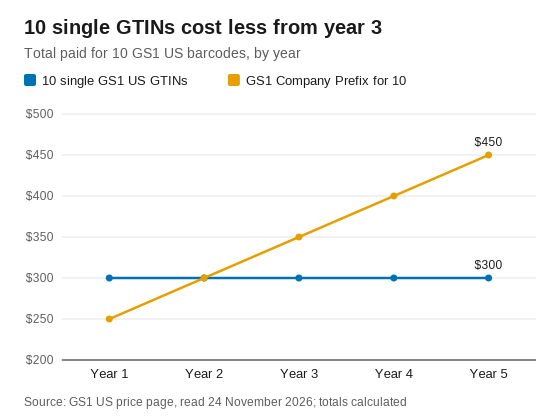
The chart shows the same totals. A single GTIN suits a seller with a few products that will not grow fast. GS1 US says a GS1 US GTIN is "not available" for some uses, such as pharmaceutical products, variable measure products, mixed cases and coupons.
Which products can get a GTIN exemption?
A GTIN exemption lets a seller list a product that has no UPC, EAN, JAN or ISBN, and it is for products that are not in the Amazon catalog yet. Amazon's GTIN exemption page lists who can apply: sellers of private-label or handmade products, products they make or brand without barcodes, parts without a product ID, bundled products, and generic, unbranded products.
You cannot get an exemption for a product that already has a GS1 barcode or any GTIN, or for a product "available in the Amazon catalog". So a reseller of an existing product cannot use it. Brands that Amazon has found to have GS1 barcodes "are not eligible for a GTIN exemption", and Amazon "may expire previous GTIN exemptions" of brands that later get GS1 barcodes.
The application needs real photos of every side of the product and its packaging. Missing sides are one of the top reasons for rejection that Amazon lists. If your brand is refused but you think it should qualify, you can ask Amazon for an exception. One case Amazon names is when you are "unable to purchase new GTINs for your product (for example, it's too expensive or has low gross merchandise sales)". A product with a GTIN exemption has no manufacturer barcode, so it still needs an Amazon barcode on every FBA unit.
Can a reseller create a bundle or a multipack with its own barcode?
A reseller is limited on both, and Amazon treats bundles and multipacks under different rules. Amazon's ASIN creation policy says sellers should not list non-standard multipacks that the brand owner or manufacturer did not create. Amazon's GTIN exemption page allows an exemption for a bundle only when each component has no existing GTIN or is part of your approved brand. So a bundle of other brands' products that carry barcodes cannot use an exemption.
A multipack made by the manufacturer that is already on Amazon is sold like any other existing product: you add your offer to its ASIN. Our guide to selling bundles on Amazon explains which bundles Amazon allows. A reseller who sends either product to FBA needs an Amazon barcode on every unit.
What to do next
Check your case before you pay for any barcode.
- Check whether the exact product is already in Amazon's catalog. If it is, add your offer to the existing ASIN and buy no barcode.
- If you send the product to FBA as a reseller, plan an FNSKU label for every unit and add the label cost to your numbers.
- If you create your own product, decide how many barcodes you need for the next few years, then compare a single GS1 US GTIN with a Company Prefix.
- Buy barcodes only from GS1, never from a barcode reseller.
- If your own product has no barcode and you do not want one, apply for a GTIN exemption with photos of all six sides.