
What labels does Amazon FBA require on units, boxes and pallets in 2026?
 Max VershininFounder of Arbitrage Hero
fbalabelsfnskufba prepshipping
Ask AI to summarize this article:





Amazon FBA labeling requirements in 2026 cover three levels: a scannable barcode on every unit, an FBA box ID label on every box, and four labels on every pallet. Resellers must use an Amazon barcode (FNSKU); brand owners may keep the manufacturer barcode. Some units and boxes also need a warning label: a suffocation warning on poly bags, "Sold as set" on bundles, an expiry date, or a lift label on heavy boxes. Amazon stopped prepping and labeling FBA units in the US on January 1, 2026, so you or your prep center apply every label before the shipment leaves.
This guide puts the US and UK limits side by side and shows two places where Amazon's own help pages disagree, with a rule that meets both. It covers general FBA labels only, not hazardous goods, Transparency codes or the special prep of liquids, sharp items and batteries. Arbitrage Hero shows the profit, fees and ROI of a deal before you buy. The labels, bags and boxes in this guide are a cost per unit that still comes out of that profit after you buy.
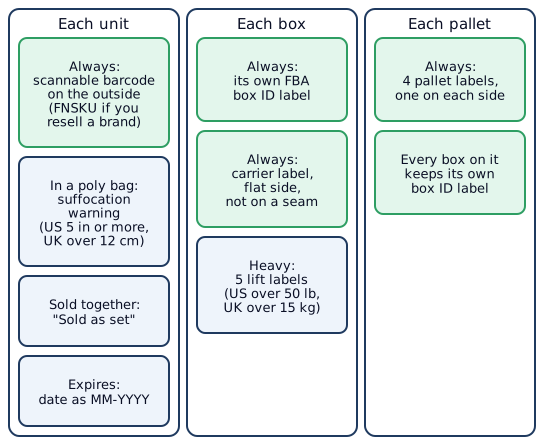
The diagram shows which labels each level carries, from the unit to the pallet.
Every FBA unit needs a scannable barcode on the outside
Every unit you send to FBA needs a barcode that Amazon can scan from the outside of the package. Amazon's US product packaging requirements ask for "an exterior scannable barcode or label" with "the corresponding human-readable numbers". The barcode must not sit on a corner or a curve.
For an arbitrage seller who resells other brands, that barcode is an Amazon barcode, the FNSKU. Amazon's page on how to use Amazon barcodes for FBA says that barcode requirements changed on March 31, 2026. It adds: "Resellers are required to use Amazon barcodes for products even if they have a manufacturer barcode". The Arbitrage Hero guide on when an FNSKU label is required explains who can still send units without one and how to switch an existing SKU.
The same Amazon page sets the rules for the label itself:
- Cover all other visible barcodes on the unit, such as the UPC, except serial number barcodes and Transparency code labels.
- Do not cover other stickers on the product, because they can hold warning or safety information.
- Keep 0.25 inch between the label and the edge of the packaging.
- Use a label between 1 x 2 inches and 2 x 3 inches, from a thermal or laser printer at 300 dots per inch or more. Do not use an inkjet printer.
A store price sticker is a different case: remove it from any unit you bought at retail. Amazon's US packaging page says Amazon "will not accept marketing materials such as pre-priced labels, pamphlets, price tags, or other non-Amazon labels".
Bagged units and sets need a warning or a set label
A poly bag needs a suffocation warning when its flat opening is 5 inches or more in the US, or more than 12 cm in the UK. Amazon's US packaging page says that "Poly bags with a 5-inch opening or larger (measured when flat) must have a suffocation warning". Amazon's UK product packaging requirements ask for the warning on bags with an opening of more than 12 cm.
5 inches is 12.7 cm, so a bag with a 12.5 cm opening needs the warning in the UK and not in the US. The simplest rule is to use bags with the warning printed on them for every market.
The UK page also sets the bag itself: at least 1.5 mil thick, transparent, and with the barcode scannable through the bag or printed on a label on the outside. A mil is a thousandth of an inch, so 1.5 mil is about 0.038 mm. The UK page writes "(0.0254 mm)" after 1.5 mil, but 0.0254 mm is 1 mil. Some guides in the current Google results write "1.5 mm", which is about 39 times thicker than Amazon's rule.
Units that you sell together as one unit need a set label. Amazon's US packaging page asks for a label that "clearly states that the products are to be received and sold as a single unit", for example "Sold as set", "Ready to ship" or "This is a set. Do not separate."
Expiry dates need a format that every Amazon page accepts
Write expiry dates as MM-YYYY: it is the one format that the US packaging page, the US expiration page and the UK packaging page all accept. For a US shipment, Amazon reads it as the first day of that month, so check the shelf life from that earlier date. The three pages disagree on the full date. The US packaging page says that "Expiration dates must be displayed in the format MM-DD-YYYY or MM-YYYY." Amazon's US page on expiration dates on FBA products calls DD-MM-YYYY the "Preferred numeric format". The UK packaging page asks for DD-MM-YYYY or MM-YYYY.
The first-day rule comes from the US expiration page, which says that for MM-YYYY "Amazon interprets the date as the first day of that month". For example, a product that expires on March 28, 2027, written as 03-2027, counts as expiring on March 1, 2027, which is 27 days earlier.
The date goes in two places. The US packaging page asks for it "on the outer box in 36-point or larger font and on the individual units". A unit in a poly bag or bubble wrap needs the date on the outside of the bag or wrap.
The product must also have enough shelf life when it arrives. Amazon's US expiration page asks for enough time "for the product to be consumed in full, plus an additional 90 days". Its example is a bottle of supplements with 240 daily servings, which needs 330 days of shelf life at check-in.
Every shipping box needs its own FBA box ID label
Every box in an FBA shipment needs its own FBA box ID label, printed from the shipment, in addition to any carrier label. Amazon's US shipping and routing requirements say that "Each box in a shipment requires an Amazon FBA Box ID label in addition to any carrier labels."
Amazon's US shipping label requirements add four rules for these labels:
- Print the full set. Each label is unique, so never photocopy or reuse one for another box.
- Put the box ID label and the carrier label on a flat side of the box, so the barcodes do not fold over an edge or a corner.
- Do not put a label on a seam or an opening of the box.
- Print with a thermal or laser printer, never an inkjet printer.
If you reuse a box that an online order arrived in, cover its old barcodes. Amazon's packaging page asks you to "Remove, cover, or render unscannable any existing scannable barcodes on the outside of shipping boxes", for example with opaque tape or a black marker.
Box size has a limit too. Amazon's US routing page allows a box with several items to be at most 36 inches long, 25 inches wide and 25 inches high. Several guides in the current results still say "25 inches on any side", which is too strict for the length. In the UK, Amazon's shipping and routing requirements set at most 63.5 cm on any side and at most 23 kg for boxes of standard-size items.
Heavy boxes need lift labels on the top and the sides
In the US, a box over 50 lb needs a "Team Lift" or "Heavy Package" label on the top and on the sides, five labels in total. Amazon's US routing page states this rule. The same page is not consistent about the limit itself. It says that boxes "must not exceed the standard weight limit of 50.00 lb, unless they contain one single item that exceeds 50.00 lb". In another passage it says that "Boxes may exceed 50 lb, but must not weigh more than 65 lb." Keep each box at 50 lb or less, and both passages are met.
The US page has two more weight rules. A single item over 100 lb needs a "Mechanical Lift" label on the top and the sides. A box with jewelry or watches may weigh at most 40 lb.
In the UK, the lift label starts at a lower weight. Amazon's UK routing page says that boxes weighing between 15 and 23 kg "must contain"Heavy parcel" label viewable from the top and sides", five labels in total. 15 kg is about 33 lb, so a UK box needs the label at a weight about 17 lb lower than a US box.
Each pallet needs four pallet labels
A pallet needs four pallet labels, one on each side, in both markets. Amazon's US routing page asks for "four FBA Pallet ID labels, one on the top center of each side". It adds that "Each box on the pallet also requires its own unique FBA Box ID label." Amazon's UK routing page asks for a pallet label "on each of the four sides". Put pallet labels on every pallet you send, whatever the carrier.
Amazon FBA labeling requirements differ between the US and the UK in four places
The UK asks for a lift label at a lower weight and a suffocation warning at a slightly smaller opening, sets box limits in centimetres and kilograms, and writes full dates day first.
| Rule | US | UK |
|---|---|---|
| Lift label on a heavy box | Over 50 lb: "Team Lift" or "Heavy Package", 5 labels | 15 to 23 kg: "Heavy parcel", 5 labels |
| Box limits | Box of several items: 36 x 25 x 25 inches; keep it at 50 lb or less, because Amazon's page also mentions 65 lb; jewelry or watches: 40 lb | Box of standard-size items: 63.5 cm on any side, 23 kg |
| Suffocation warning on a poly bag | Opening of 5 inches or more | Opening of more than 12 cm |
| Full expiry date on the packaging page | MM-DD-YYYY (MM-YYYY also accepted) | DD-MM-YYYY (MM-YYYY also accepted) |
What to do next
Before you seal an FBA shipment, check the unit barcodes, the warnings and dates each unit needs, the box weights and the box labels.
- Before you buy, check whether the product needs a bag, bubble wrap or an expiry date. Each one adds a cost per unit to the deal.
- Remove store price stickers, and cover old barcodes on any box you reuse.
- If you resell another brand's product, print one FNSKU label per unit. Cover the other visible barcodes, except serial number barcodes and Transparency labels, and leave warning and safety labels visible. Put the FNSKU label on a flat outside surface, outside any bag.
- Use poly bags with a printed suffocation warning, and add a "Sold as set" label to bundles.
- Write expiry dates as MM-YYYY on each unit and on the box, in 36-point type or larger on the box. For US shipments, Amazon reads MM-YYYY as the first day of the month, so check the shelf life from that date.
- Weigh every box. Keep US boxes of several items at 50 lb or less, and boxes with jewelry or watches at 40 lb or less. For a UK box of standard-size items that weighs 15 to 23 kg, add five "Heavy parcel" labels, and keep the box at 23 kg or less.
- Print the box ID labels from the shipment, one per box. Put the box ID label and the carrier label on a flat side, with neither barcode folded over an edge or a corner.
If you would rather not prep at all, read what a prep centre charges before you choose one. The Academy lesson on how to create your first shipment walks through the Send to Amazon steps. In October, also check when to stop sending stock into Q4 for Amazon's inbound cut-off dates.
Does Amazon still prep and label FBA units in the US?
No. Amazon's US FBA Prep Service page says that, starting January 1, 2026, Amazon no longer offers "prep and item labeling services" for FBA shipments in the US store. The same page says that shipments created after January 1 that arrive "without proper prep and item labeling won't be eligible for reimbursement if damaged or untraceable". So a US seller or their prep center now applies every unit label before the shipment leaves.
Does Amazon supply Team Lift or Heavy parcel labels?
No. Amazon's US and UK shipping and routing requirements both say that Amazon does not provide the "Team Lift", "Mechanical Lift" or "Heavy parcel" labels for now. You make them yourself, in the language of the country the shipment goes to, so in English for Amazon US and Amazon UK. In the US, a box over 50 lb needs five "Team Lift" or "Heavy Package" labels on the top and the sides, and a single item over 100 lb needs "Mechanical Lift" labels. In the UK, a box of 15 to 23 kg needs five "Heavy parcel" labels on the top and the sides.
What happens if units arrive at FBA without the right labels?
For US FBA shipments, Amazon's product packaging requirements say that inventory arriving with "non-compliant, unsafe packaging may be refused or disposed of at your expense and will not be eligible for reimbursement". The same page says that "Amazon may refuse, return, or repackage any product delivered to a fulfillment center with inadequate or non-compliant packaging or labelling". For boxes, Amazon's US shipping label page warns that a missing FBA box ID label "may lead to blocking of future shipments".