
What AI Does For Online Arbitrage Sourcing, And What It Invents
 Max VershininFounder of Arbitrage Hero
aichatgptproduct researchonline arbitragesourcing software
Ask AI to summarize this article:





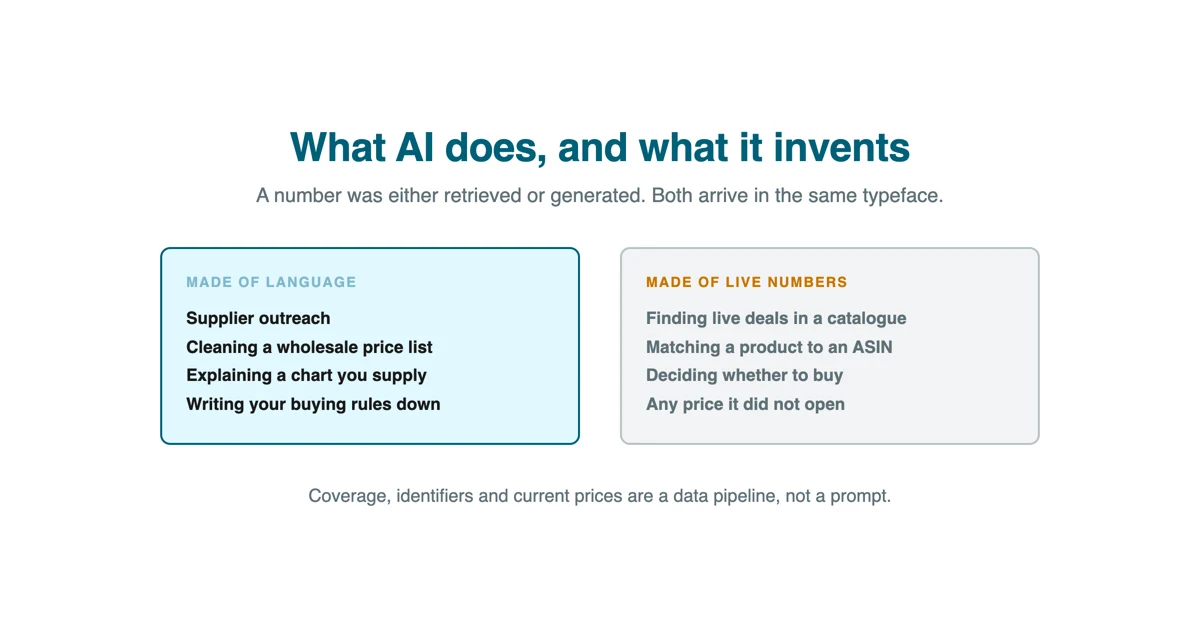
Short answer: a language model is very good at the parts of online arbitrage that are made of language, and structurally incapable of the part that is made of live numbers. It will write your supplier email, clean a messy wholesale price list, explain what a fee change means for your margins, and talk you through a rank history in plain words. It will not tell you that this product costs $12 at a shop today and sells for $25 on Amazon today, and the reason is not that the models are not clever enough yet. It is that the answer is not knowledge. It is a measurement, and measurements have to be taken.
The confusion is understandable, because the failure does not look like a failure. Ask for ten profitable products and you get ten. They have plausible names, plausible prices and plausible margins. Nothing about the output signals that the numbers were composed rather than looked up. That is the specific risk worth understanding, and it is worth understanding it well enough to still use the tool, because there is real work here that it does properly.
The distinction that explains every result you will get
There are two ways a number can appear in an answer. It was retrieved, meaning something went and read it from a source that knows. Or it was generated, meaning the model produced the most plausible-looking value given everything around it. A retrieved number can be right or out of date. A generated number has no relationship to the world at all.
Both arrive in the same typeface. So the only reliable question to ask of any figure in an AI answer is: where did this come from, and can I open it? If the answer does not have a link behind it, treat it as fiction, however confident the sentence sounds. This is not pessimism about the technology. It is the same standard you would apply to a number a stranger told you in a forum.
| The job | Made of | Verdict |
|---|---|---|
| Finding live deals across a store's catalogue | Live prices, catalogue coverage, matching, arithmetic | No. Wrong tool entirely |
| Explaining a Keepa chart you are looking at | Interpretation of something you supply | Yes, and genuinely useful for learning |
| Turning a supplier PDF into a clean spreadsheet | Structure, not facts | Yes. One of the strongest uses |
| Writing outreach to brands and distributors | Language | Yes, with your own facts pasted in |
| Deciding whether a specific ASIN is worth buying | Live price, fees, rank, competition | No, unless every input is retrieved and shown |
| Summarising your own sales export | Arithmetic on data you provide | Yes, if you check the totals |
Why "find me profitable products" cannot work
Even with web browsing switched on, and this is the part that surprises people. Browsing changes the model from "no data" to "a few pages of data", and a few pages is not what sourcing needs. Sourcing is a coverage problem before it is an intelligence problem.
A scan across one mid-sized retailer means reading tens of thousands of product pages, matching each one to the right Amazon listing by identifier rather than by name, pulling the current Amazon price and the fee profile for that size and category, checking the rank history to see whether it sells at all, and counting who else is on the listing. Then repeating it tomorrow, because both prices moved. An agent reading pages one at a time does perhaps a few dozen before it runs out of budget, and its matching is done on titles, which is exactly where the errors are.
There is also a subtler problem underneath the throughput one. The identifier is what makes a match trustworthy. A name match will happily pair a 3-pack with a single, a 500ml with a 750ml, or this year's formulation with last year's, and every one of those produces a beautiful margin that does not exist. This is the same failure that makes manual sourcing slow and error-prone, and it is why the matching key, not the search, is the hard part of the whole business.
Run the test yourself, it takes five minutes
This is worth doing once, because the result is more persuasive than any argument. Ask any general assistant for ten profitable online arbitrage products with buy price, Amazon price and ROI. Then check each one: open the retailer page and open the Amazon listing.
What comes back tends to fall into four groups. Some products do not exist in the form described. Some exist but the retail price is old, sometimes by a year or more. Some are matched to the wrong Amazon listing, usually a different pack size. And a few are real, currently unprofitable, and were profitable at some point in the past, which is the most instructive category of all: the model has learned what a good deal looks like, and it is reconstructing one from memory rather than finding one in the world.
Do the same test on a task made of words. Paste in a supplier's price list and ask for it as a table with unit costs calculated. Paste a rejection email from a brand and ask what it is actually asking for. The difference in quality is not subtle, and once you have seen both, the line between the two kinds of work stops being theoretical.
Where it earns its keep
All six of these are things sellers spend real hours on, and none of them require the model to know a single live fact.
- Supplier and brand outreach. Give it your real business details and the specifics of what you want, and it will write a first approach that reads like a business rather than a template. Rewriting the same email for the fortieth distributor is exactly the sort of work worth handing over.
- Data cleaning. Wholesale price lists arrive as PDFs, badly merged spreadsheets and scans. Converting them into a consistent table with codes, pack sizes and unit costs is tedious, mechanical, and something a model does well. Check the totals afterwards, because arithmetic done in prose is where they slip.
- Learning the mechanics. Fee structures, rank behaviour, what a particular chart is showing. Paste the page or the screenshot and ask for it in plain words. It is a patient tutor on material you can verify immediately.
- Writing your own rules down. Describe how you decide on a buy and ask it to turn that into a checklist or a set of filter values. This is genuinely valuable because it forces the criteria out of your head into a form you can apply consistently.
- Post-mortems. Paste the numbers from a lot that went badly and ask what the warning signs were. It is thinking with you about data you supplied, which is the mode where it is most reliable.
- Reading your own reports. Sales exports, returns, storage bills. Ask for the pattern. Verify the arithmetic before acting on it.
What an agent would actually need to source properly
It is worth listing, because the list is short and it explains why sourcing software exists as a separate thing rather than as a prompt.
- Coverage of a store's catalogue, not a sample of it.
- Matching on identifiers rather than on product names.
- Current Amazon prices and the current fee model for each size and category.
- Rank history, so that a product nobody buys is filtered out before it reaches a human.
- Competition on the listing, including whether Amazon itself is on it.
- A repeat of all of the above, because the answer expires within a day.
That is a data pipeline. It is what Arbitrage Hero is, and it is why the useful division of labour is so clean: the pipeline measures, and the model helps with everything that is words around the measurement. Our reverse search starts from an Amazon listing and finds the stores selling it, and our FBA calculator does the fee arithmetic against a real buy price. Neither is guessing, and neither needs to be clever.
Four rules for using it without getting hurt
- Never let a generated number reach a buying decision. If you cannot open the page the figure came from, it is not a figure.
- Use it for words, use software for arithmetic. The failure modes are completely different and so are the tools.
- Ask for sources and then actually open them. A cited link that says something else is a common outcome, and checking takes seconds.
- Watch for confident summaries of your own data. When you paste a sales export and ask what it shows, verify the totals. This is the one case where the answer feels safe because the data was yours, and it is where an unnoticed arithmetic slip does the most damage.
Frequently asked questions
Can ChatGPT find profitable Amazon arbitrage products?
Not reliably, and not because of a limitation that will be fixed by a better model. Finding a live deal requires current prices from both sides, matching by product identifier rather than by name, and coverage of a whole catalogue rather than a handful of pages. A language model without those inputs produces plausible figures instead of measured ones, and the two look identical on screen. Test it and check ten results against the actual retailer and Amazon pages; the pattern shows up immediately.
Does web browsing fix the problem?
It helps with staleness and does nothing for coverage. Browsing lets an assistant read a few pages, and sourcing means reading tens of thousands and repeating it as prices move. It also does not fix matching, which is the deeper issue: pairing a retail product to the correct Amazon listing has to be done on an identifier, because name matching cheerfully pairs different pack sizes and produces margins that do not exist.
What is AI genuinely good for in an arbitrage business?
Everything made of language rather than live facts. Writing supplier and brand outreach, turning messy wholesale price lists into clean spreadsheets, explaining fee structures and rank behaviour while you learn them, turning your own buying rules into a written checklist, and reviewing a lot that went badly to name the warning signs. All of those save real hours, and none of them require the model to know a current price.
Will AI replace online arbitrage sourcing software?
What would replace sourcing software is an agent with the same data underneath it: full catalogue coverage, identifier-level matching, live prices on both sides, the current fee model, rank history and listing competition. That is a data pipeline rather than a model, so the likely direction is the two joining rather than one replacing the other, with software doing the measuring and a model handling the language around it. The measuring part does not go away.
Keep reading
- The modern online arbitrage stack sets out the six jobs a sourcing setup has to cover, which is the checklist any agent would have to meet.
- How accurate Amazon sales estimates are is a worked example of checking a number instead of trusting it.
- Reverse sourcing done properly covers the matching problem from the practical side.
- The best online arbitrage software compares what the tools in this category actually do.
- Finding deals in three minutes is the same task done with measurement rather than generation.