
How online arbitrage works in the UK: stores, VAT and Amazon fees
 Max VershininFounder of Arbitrage Hero
online arbitrageamazon ukvatuk storesfba fees
Ask AI to summarize this article:





Online arbitrage in the UK means buying products on UK retail websites and reselling the same products on Amazon.co.uk, usually through FBA. For online arbitrage UK sellers, three things decide what is left from each sale: the price gap, VAT, and Amazon's fees. VAT depends on whether you are VAT-registered, whether the store gave you a VAT invoice, and where your business is based. In our hypothetical example with 20% VAT, an £8.00 purchase and a £15.99 sale leave an estimated £5.33 to £7.99 before Amazon fees, shipping, labels, storage and returns.
Arbitrage Hero scans 176 UK stores, matches their products to Amazon UK listings and calculates the profit after Amazon's fees. The store counts below come from its store directory, and the VAT rules come from HMRC.
How online arbitrage works in the UK, step by step
A UK online arbitrage deal goes through six steps, from a store price to a unit in an Amazon warehouse.
- Find a product that a UK retail website sells for less than its price on Amazon.co.uk, often in a sale or on a clearance page.
- Match it to the Amazon listing by its barcode, and check that the pack size and the variant are the same.
- Check that the product sells (sales rank and price history) and that your account may sell the brand and the category.
- Calculate the profit after Amazon's fees and after VAT, as VAT applies to you.
- Buy a small batch, and keep the receipt or the VAT invoice.
- Check the barcode and labelling rules for the products in your shipment, apply any FNSKU labels they need, and send the stock to Amazon.
Arbitrage Hero matches store products to Amazon listings mainly by barcode, with title matching as a fallback. It calculates the profit from the store's buy price, the Amazon price and Amazon's fees for that product. You still check your own selling permissions and apply your own VAT position. The Academy lesson on how to source online arbitrage products by hand shows the same steps with Argos as the example.
Which UK stores do online arbitrage sellers buy from?
Online arbitrage sellers can buy from any UK retail website that sells a product for less than its price on Amazon.co.uk. In Arbitrage Hero's store directory on 27 October 2026, the UK stores with the most products matched to Amazon listings are House of Fraser with about 408,000, Studio with about 272,000 and Robert Dyas with about 217,000. These counts help you choose which catalogues to look at first.
| # | UK store | Products matched to Amazon listings (rounded) |
|---|---|---|
| 1 | House of Fraser | about 408,000 |
| 2 | Studio | about 272,000 |
| 3 | Robert Dyas | about 217,000 |
| 4 | Asos | about 213,000 |
| 5 | John Lewis & Partners | about 202,000 |
| 6 | M&S | about 172,000 |
| 7 | Hit.co.uk | about 165,000 |
| 8 | Office Stationery | about 157,000 |
| 9 | Hamleys | about 157,000 |
| 10 | HMV | about 146,000 |
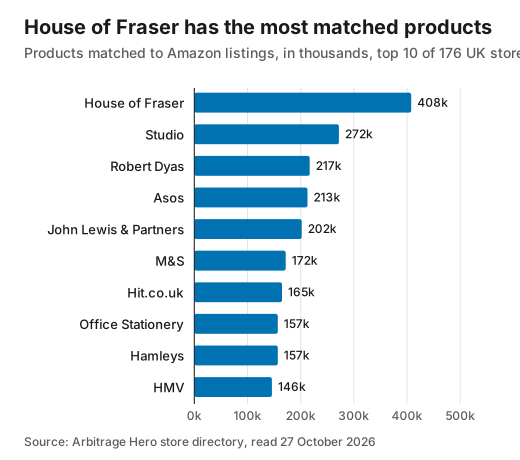
After the top three come Asos with about 213,000 matched products, John Lewis & Partners with about 202,000 and M&S with about 172,000. Hit.co.uk has about 165,000, Office Stationery and Hamleys about 157,000 each, and HMV about 146,000. Several well-known high-street names have much smaller matched catalogues in the same directory: Argos about 43,000, Superdrug about 8,000, Currys about 3,000, Holland & Barrett about 600 and Boots about 500.
Summed across all 176 UK stores, the directory shows about 4.8 million store-product matches, which can count one product at several stores. The median store has about 7,500 matches, and the 10 largest stores hold about 44% of that sum.
The store counts are the rounded figures Arbitrage Hero's directory showed on 27 October 2026. They measure matched products, not profitable or eligible deals. A store with a small matched catalogue can still hold a good deal on the day of a sale. The full list is on the page of the 176 UK stores Arbitrage Hero scans.
When does a UK online arbitrage seller have to register for VAT?
A business based in the UK must register for VAT when its taxable turnover for the last 12 months goes over £90,000, according to HMRC's Register for VAT guide, checked on 27 October 2026. It must also register when it expects its taxable turnover in the next 30 days alone to go over £90,000. HMRC defines taxable turnover as the total value of sales that are not VAT exempt or out of scope, which is not the same as profit. For example, a seller with £8,000 of taxable Amazon sales a month has £88,000 after 11 months and £96,000 after 12 months, so the turnover goes over £90,000 in the 12th month.
For the turnover of the last 12 months, HMRC's guide sets the deadline at 30 days after the end of the month in which the turnover went over the threshold. For turnover expected in the next 30 days, the deadline is the end of that 30-day period. A business that registers late must pay VAT on the sales it made since the date it should have registered. A business below £90,000 can also register by choice.
From the effective date of registration, HMRC's guide says a business can charge VAT on its sales and reclaim VAT on what it buys. A UK seller who is not registered charges no VAT on Amazon sales and cannot reclaim the VAT in a store price, so the full store price is the cost. For a registered UK seller of standard-rated goods, the sale price includes VAT that the seller pays to HMRC. The seller can reclaim the VAT on stock with the right VAT evidence, as the next section explains. This guide describes HMRC's published rules and is not tax advice. Check your own case with HMRC or an accountant.
Which receipt lets a VAT-registered seller reclaim the VAT?
A VAT-registered online arbitrage seller should get a VAT invoice from the store to reclaim the VAT in the store price. HMRC's VAT Notice 700/21 calls the VAT invoices a business receives "the primary evidence" to recover VAT. The same notice says a retailer does not have to issue a VAT invoice unless the customer asks for one, so ask the store for a VAT invoice with each order.
For a charge of £250 or less including VAT, Notice 700/21 lets a retailer issue a short VAT invoice. It shows the retailer's name, address and VAT registration number, the time of supply, a description of the goods, the total including VAT and the VAT rate. The buyer's name is not on that list. Above £250, the retailer must issue a full or a modified VAT invoice when asked. For example, 31 units at £8.00 cost £248 and fit the short form, while 32 units cost £256 and need the full or the modified invoice.
Do sellers based outside the UK pay UK VAT on Amazon sales?
Sellers based outside the UK have no £90,000 threshold, according to HMRC. For their goods held in the UK, Amazon accounts for the VAT on sales to consumers. A seller who makes only these zero-rated deemed supplies to Amazon can register for VAT or apply to HMRC for exemption from registration. A sale to a UK VAT-registered business that gives its VAT number requires the seller to register and account for the VAT.
HMRC's Register for VAT guide says that a person and a business based outside the UK must register, whatever the turnover, if they supply goods to the UK. HMRC's guidance on VAT and online marketplaces, checked on 27 October 2026, makes the marketplace liable for the VAT on goods of any value that are in the UK at the point of sale and sold by an overseas business. Stock bought from UK stores and stored in Amazon's UK warehouses is such stock.
The same guidance treats the overseas seller as making a zero-rated sale to Amazon, which HMRC calls a "deemed supply". The Register for VAT guide adds that every taxable sale of a seller based outside the UK must be zero-rated to get the exemption.
What VAT does to one £15.99 online arbitrage deal
For a hypothetical toy bought for £8.00 including 20% VAT and sold to a consumer for £15.99 on Amazon.co.uk, an estimated £5.33 to £7.99 is left before Amazon fees, shipping, labels, storage and returns. The amount depends on VAT registration and on whether the VAT on the stock is reclaimed. The sale price is the same as the toy's in our article on Amazon FBA fees in the UK.
Both prices are hypothetical calculation inputs, not current offers. The UK standard rate of VAT is 20% (GOV.UK, VAT rates). The buyer pays £15.99 in every row, and that price includes 20% VAT only where VAT is due: when the seller is registered, or when Amazon accounts for it. The VAT inside a price that includes 20% VAT is one sixth of it: £2.67 of £15.99 and £1.33 of £8.00. The overseas row assumes goods held in the UK, only zero-rated deemed supplies and an exemption from registration granted by HMRC.
| Seller | Sale price kept | Stock cost | Left before Amazon fees |
|---|---|---|---|
| UK, not VAT-registered | £15.99 | £8.00 | £7.99 |
| UK, VAT-registered, with a VAT invoice from the store | £13.33 | £6.67 | £6.66 |
| UK, VAT-registered, no VAT reclaimed on the stock | £13.33 | £8.00 | £5.33 |
| Based outside the UK, HMRC exemption from registration, consumer buyer | £13.33 | £8.00 | £5.33 |
A UK seller who is not VAT-registered keeps the whole £15.99 and pays £8.00, so £7.99 is left. A VAT-registered UK seller pays the £2.67 inside the sale price to HMRC and reclaims the £1.33 inside the store price with a VAT invoice, so £6.66 is left. If the seller does not reclaim the £1.33, it stays a cost and £5.33 is left.
What the estimate assumes and leaves out
For the seller based outside the UK, with goods held in the UK, a consumer buyer and an HMRC exemption from registration, Amazon accounts for the £2.67 under HMRC's online marketplace rule. The seller cannot reclaim the £1.33 in the store price, so £5.33 is left.
The figures are estimates for one example. Each result is calculated from unrounded values, and each amount shown is rounded to the penny on its own, so a row can differ by a penny from a subtraction of the rounded amounts. The figures leave out Amazon's fees, shipping to Amazon, labels, storage and returns. Our UK fees article calculates Amazon's fees on a toy with the same price, and it explains that a UK seller who is not VAT-registered also pays VAT on those fees.
Which Amazon fees apply to online arbitrage in the UK?
Amazon UK charges a referral fee on each sale, plus either a monthly Professional plan fee or an Individual fee per item sold, according to Amazon's Seller Central UK page on selling fees, checked on 27 October 2026. With FBA, the seller also pays a fulfilment fee on each unit Amazon ships. A digital services fee is added to the selling and FBA fees on every sale in the UK store.
- The selling plan: the Professional plan costs £25 a month, and the Individual plan costs £0.75 for each item sold. The £25 applies when you list only in Amazon's European stores; with an account merged with stores in other countries, a different fee may apply. The Academy lesson on the Individual and Professional selling plans shows where the two plans break even.
- The referral fee: a percentage of the price the buyer pays, which depends on the category, and in many categories a minimum per item. Toys and Games pays 15% of the price the buyer pays, with a minimum of £0.25.
- The digital services fee: 2% of Amazon's selling and FBA fees on UK store sales, for sellers established in the UK and in most other countries. Sellers established in France, Italy, Spain or Canada pay 3% of those fees.
- The FBA fees: the fulfilment fee depends on the size and weight of the unit, and storage is charged each month. Our article on Amazon FBA fees in the UK gives the 2026 rates, the fuel and logistics surcharge and VAT on fees.
What to do next
Before you buy stock for UK online arbitrage, find your VAT case, get the right invoice from the store and calculate the deal after Amazon's fees.
- Find your VAT case in HMRC's Register for VAT guide: a UK business below £90,000, a UK business above it, or a business based outside the UK.
- If you are VAT-registered, ask each store for a VAT invoice and keep it with the order.
- Pick a few stores from the directory, then check each deal's sales history and your right to sell the brand.
- Calculate one deal with your own VAT case and Amazon's fees before you buy more than a small batch.