
Where The Margin Comes From: Cashback, Portals And Card Stacking
 Max VershininFounder of Arbitrage Hero
cashbackmarginroibuyingonline arbitrage
Ask AI to summarize this article:





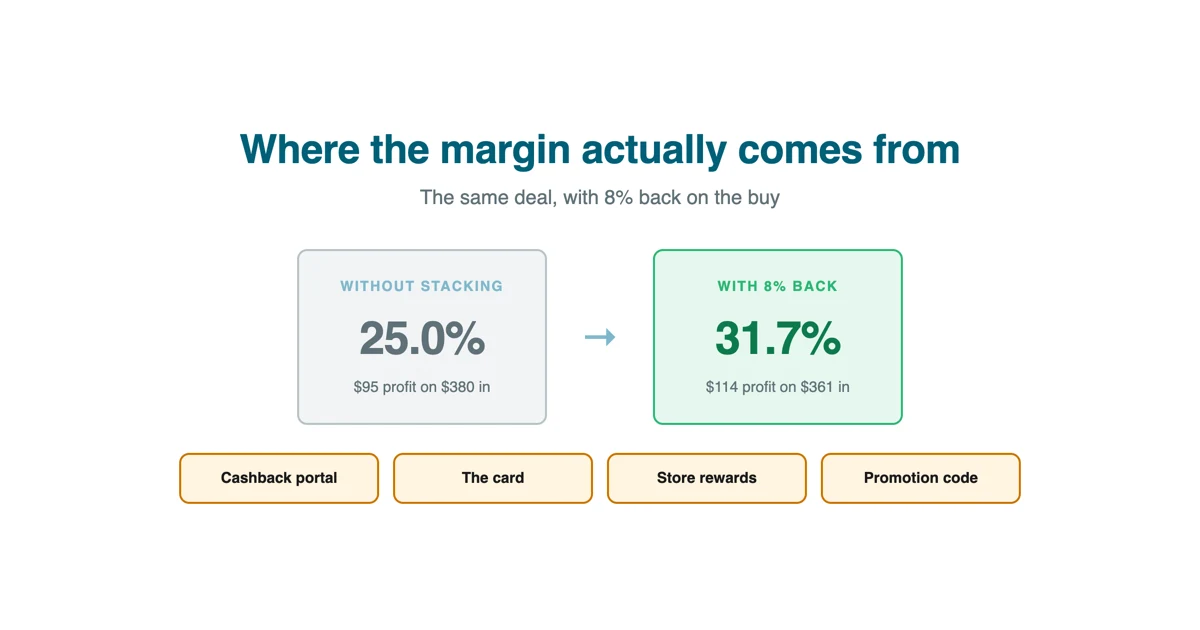
Short answer: the buy price in your scan is not the price you pay. Between the checkout page and your bank statement there are four places money comes back: a cashback portal, the card you paid with, the retailer's own rewards scheme, and whatever promotion you applied. Each one is small. Stacked against a thin arbitrage margin they are not small at all, because they land on the cost side of a return-on-investment sum, where a few percent off the buy price moves the return by several times that.
This is also the part of online arbitrage that is most often either ignored or overdone. Ignored, it is the difference between a deal you reject and a deal you take. Overdone, it becomes the reason people buy stock that does not sell, because a guaranteed 8% back feels more real than an uncertain 30% profit. Both mistakes come from the same place: not doing the arithmetic.
Why does a few percent back matter so much?
Because return on investment is a ratio, and money off the buy price improves both halves of it at once. Take a deal with figures that would be unremarkable in any scan.
| Without stacking | With 8% back on the buy | |
|---|---|---|
| Buy price, 20 units at $12 | $240.00 | $220.80 |
| Amazon fees and prep, 20 units | $140.00 | $140.00 |
| Total invested | $380.00 | $360.80 |
| Sold at $25, net after fees | $475.00 | $475.00 |
| Profit | $95.00 | $114.20 |
| Return on investment | 25.0% | 31.7% |
Eight percent off the buy price raised the profit by 20% and the return by nearly seven points. That is the whole argument. It works because the saving is subtracted from money you had to put in, not added to money you got out, and the ratio moves on both sides.
The same arithmetic explains why stacking matters more the thinner the deal is. On a 60% return the extra points are pleasant. On a 20% return they are the difference between a deal worth doing and one that pays you for the risk of holding stock. And because most scan results sit nearer the bottom of that range than the top, the buy-side percentage is doing more work than most sellers realise.
The four layers, and what each one is worth
They stack in a specific order, and the order matters because each layer is calculated on a different number.
| Layer | Typical range | Calculated on | When the money arrives |
|---|---|---|---|
| Cashback portal | 1% to 10%, occasionally higher on a promotion | The order subtotal, usually after discounts and never on tax or shipping | Weeks to months, after the retailer's return window closes |
| The card | 1% to 5%, or a category bonus | The full amount charged, tax included | The next statement |
| Retailer rewards | 1% to 5%, often as store credit | Qualifying items only, and the exclusions are long | Immediately or at the next threshold |
| Promotion codes | Whatever the code is | The basket, before everything else | At checkout, so it is the only certain one |
Two of those four are certain, and two are not. The promotion code and the card reward are effectively guaranteed: one is applied before you pay, the other is a contractual term of the card. Portal cashback and retailer rewards are conditional, and the conditions are the part worth reading.
Where stacked cashback actually goes wrong
Every failure below is ordinary and most sellers meet several of them in the first year.
- The promotion code voids the portal. Many portals exclude orders that used a code from anywhere except the portal itself. The two largest levers cancel each other, and you find out ten weeks later when the tracked amount does not appear.
- Cashback is tracked, not owed. An ad blocker, a second tab, an autofilled coupon extension or a click that did not register means no tracking, and with no tracking there is nothing to claim. Portals honour claims sometimes and not always.
- It arrives after the return window on purpose. That is not a delay, it is the design: the portal pays once the retailer can no longer reverse the sale. So the money is real but it is never available when you need to buy the next lot.
- A return takes the cashback with it. Cancel or return part of the order and the associated cashback is clawed back, often silently.
- Store credit is not cash. Retailer rewards paid as credit only convert into margin if you were going to buy there again anyway. Counting it as cash inflates your recorded return and quietly ties you to one shop.
- Discounted gift cards lock up capital. Buying store credit at a discount is a real 3% to 8% lever, and it converts working capital into money that can only be spent in one place. In a business where cash flow is the binding constraint, that is a trade, not a free saving.
- Reseller detection. Retailers cancel orders and close accounts for buying quantities that look like resale, and a cashback account tied to the same identity can go with it. Multiple accounts to work around this generally breaches the terms of both the retailer and the portal.
Should cashback change which deals you buy?
No, and this is the most important paragraph here. Cashback should change how much margin you keep on the deals you were going to buy anyway. It should not change which deals pass your filter, and the reason is that the two numbers have completely different reliability. The sell-through rate and the fee stack decide whether the deal works. Cashback decides how well it works if it works at all. A product that does not sell returns nothing, and 8% of nothing is nothing, while the storage bill runs anyway.
The practical form of that rule: set your return floor without cashback in it, buy only deals that clear the floor on their own, and treat everything you get back as buffer against the things that go wrong. There are plenty of those. Prices drop between your purchase and your first sale, a competitor with 400 units lands on the listing, a unit comes back damaged. Stacked cashback is exactly the right size to absorb that class of surprise, and exactly the wrong size to justify a marginal buy.
How do you record it so it is not invisible?
Cashback that is not recorded per order is a rounding error you feel good about. Recorded properly it is a line you can manage. Three habits do it.
- Write the expected amount on the order the day you place it. One column: portal rate, card rate, expected total. Anything you record months later, when the payment lands, has lost the link to the order that earned it.
- Treat it as a reduction in cost of goods, not as income. This is what makes it show up in the return on each deal instead of as a mysterious deposit. It also keeps your per-unit cost honest for repricing decisions, where the floor price should be built on what the unit actually cost you.
- Reconcile once a month and chase what did not track. Portals have claim windows measured in weeks. A monthly pass over expected against received is enough to catch the misses while they can still be claimed.
If you use custom fields to track your buying, the expected rate belongs there next to the buy price, so that every export carries it. Our custom fields exist for exactly this class of per-deal information.
A worked routine that takes about a minute per order
- Check the portal rate for that retailer before opening the site, and check a second portal, because rates on the same shop differ by several points on any given day.
- Decide between the code and the portal if the retailer excludes one, and take whichever is worth more on this basket rather than by habit.
- Start the session from the portal link, in a clean window, with coupon extensions off, and do not open the retailer in another tab afterwards.
- Pay with the card that pays the most for this category, having checked that its reward is not capped or already spent for the quarter.
- Record the expected cashback on the order line, then screenshot the confirmation, which is what a claim needs later.
Once that routine is habit it costs almost nothing per order and it compounds over hundreds of them. The sourcing itself is the part worth spending real time on, which is where Arbitrage Hero does the work: scanning the stores, matching against Amazon and filtering by the numbers that decide whether a deal is a deal. Cashback is the last few points on top of a decision that has already been made properly.
Frequently asked questions
Is cashback stacking allowed by Amazon?
It has nothing to do with Amazon. Cashback is a term between you, the retailer and the portal, on the buying side of the business, and Amazon has no view on what you paid for your stock. What Amazon does care about is that the units are genuine and that you can document where they came from, which is a separate question and a much more consequential one. The constraints on stacking come from the portal and retailer terms, not from the marketplace.
Do promotion codes cancel portal cashback?
Often, yes. Many portals exclude orders where a code from another source was used, and that exclusion is in the terms rather than on the offer page. When both are available, compare them on the actual basket: a 15% code usually beats a 5% portal rate, and stacking both is only reliable when the portal explicitly says its offer works with retailer promotions. Assuming they stack is how sellers lose the larger of the two.
How long does cashback take to arrive?
Weeks at best and several months commonly, because portals pay after the retailer's return window has closed and the sale can no longer be reversed. Plan your cash flow as though it is not coming, then treat it as a top-up when it does. Anyone who counts unpaid cashback as available capital ends up short at the exact moment a good deal appears, which is the worst possible time to be short.
Are discounted gift cards worth it for arbitrage?
They are a genuine few points, and they cost you flexibility. Money in a store card can only be spent at that store, so you have swapped a discount for a commitment to keep buying there whether or not that shop has the best deals next month. Buy them in amounts you are confident of spending within weeks, from sources you trust, and never in a size that would leave you unable to act on a deal somewhere else.
Should I raise my ROI filter if I get cashback?
Keep the filter where it is and let cashback be the buffer. The point of a return floor is to reject deals whose margin cannot survive the ordinary bad news of this business: a price drop, a slow month, a returned unit, storage running longer than you planned. If you lower the floor because you expect a few points back, you have spent the buffer before the risk arrives. The floor answers whether the deal works; cashback answers how well.
Keep reading
- Amazon FBA fees in 2026 is the other side of the same sum: what comes off the sale before any of this reaches you.
- Reverse sourcing done properly is where the deals themselves come from.
- Choosing replenishable products matters here because stacking pays back most on the lines you buy again and again.
- Ten beginner mistakes in online arbitrage includes the one this article is really about: buying for the discount instead of for the sale.
- The FBA profit calculator gives you the fee side against a real buy price, which is the number the stacking is applied to.